Engagement: Consultation and Accommodation - Guidelines for Federal Officials to Fulfill the Duty to Consult
Current Status: Closed March 31, 2026
The regional engagement is now complete and work is underway to draft new Federal Consultation and Accommodation Guidelines.
On this page
What
The Duty to Consult
In 2004, through the Haida and Taku River decision, followed by the Mikisew Cree decision in 2005, the Supreme Court of Canada established that the Crown is obligated to consult and, if necessary, accommodate when considering actions that could potentially affect established or potential Aboriginal or Treaty rights. The duty stems from the Honour of the Crown and is derived from Section 35 of Canada's Constitution Act, 1982, which recognizes and affirms Aboriginal and treaty rights. The Court interpreted that this obligation is linked with the Crown's distinct relationship with Indigenous Peoples.
Consultation and Accommodation Guidelines
The Aboriginal Consultation and Accommodation - Updated Guidelines for Federal Officials to Fulfill the Duty to Consult - March 2011 outline the overarching approach to consultation and accommodation for the Government of Canada.
"Crown conduct" refers to projects or activities by the provincial, territorial and federal governments. The Government of Canada has responsibility for its actions undertaken, either directly or by a third party through issuing an authorization, permit or financing for enabling an activity. Consultation must occur prior to a decision and implementation of a project or activity.
Why
Budget 2023 provided $11.4 million over 3 years, for Crown-Indigenous Relations and Northern Affairs Canada (CIRNAC) to engage with Indigenous groups to renew the Aboriginal Consultation and Accommodation - Updated Guidelines for Federal Officials to Fulfill the Duty to Consult - March 2011.
Renewing the guidelines is essential to support federal officials in meaningfully meeting the duty to consult by providing more clarity on how the government will proceed to ensure an effective and efficient whole-of-government approach to consultation and accommodation. The new guidelines will serve to:
- strengthen Indigenous–Crown relationships
- promote partnerships
- contribute to Government of Canada priorities relating to economic development, regulatory efficiency and clean growth, and to the United Nations Declaration on the Rights of Indigenous Peoples Act
- advance reconciliation
- support Indigenous Peoples' self-determination
The duty to consult is an important part of the federal government's activities, including for:
- regulatory project approvals
- licensing and authorization of permits
- operational decisions
Departments and agencies are responsible for understanding how and when their activities could have an adverse impact on Section 35 rights.
What does meaningful engagement mean?
The Government of Canada is committed to renewing the relationship with Indigenous Peoples, based on recognition of rights, respect, co-operation and partnership. Consultation and engagement activities are a reflection of the government's commitment to a whole-of-government approach to Nation-to-Nation and Inuit-to-Crown relationships and therefore, the participation of Indigenous Peoples in the renewal of the guidelines is crucial to this exercise.
The Consultation and Accommodation Unit of CIRNAC has partnered with Naut'sa mawt Resource Group to host the engagement sessions with Indigenous Peoples across the country. Naut'sa mawt Resource Group is an Indigenous-owned firm that provides engagement and facilitation services to promote meaningful inclusion of Indigenous voices.
Who
The regional engagement sessions targeted consultation experts from:
- First Nation, Inuit, and Métis rights-holders
- Modern Treaty Nations and self-governing Indigenous governments
- Indigenous representative organizations at the national and regional level
The process
The purpose of the engagement was to have discussions with Indigenous Peoples and learn about their perspectives and experiences with federal consultation processes and how new guidelines could better ensure that consultation processes are meaningful and adequate, with a focus on improving Crown-Indigenous relationships.
Process flow
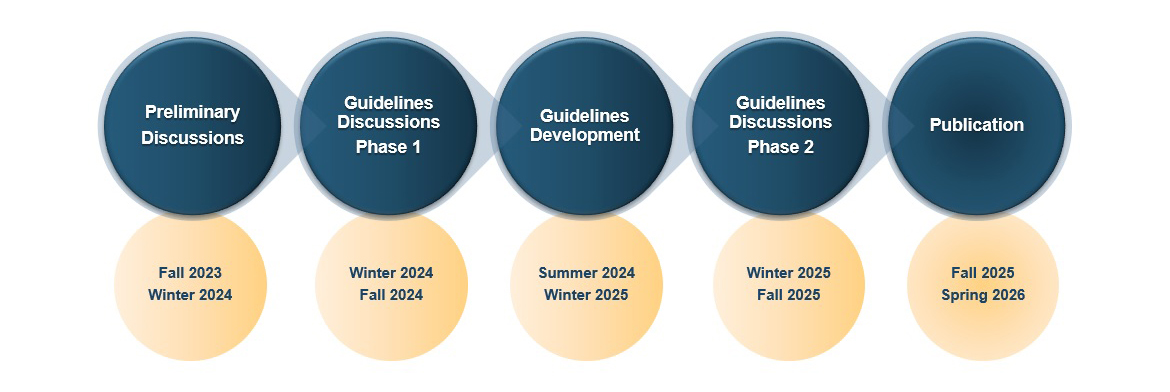
Text alternative for Process flow
- Preliminary Discussions: Fall 2023 to Winter 2024
- Guidelines Discussions - Phase 1: Winter 2024 to Fall 2024
- Options for New Guidelines: Summer 2024 to Winter 2025
- Guidelines Discussions - Phase 2: Winter 2025 to Fall 2025
- Guidelines Finalization and Publication: In 2026
Preliminary engagement
Preliminary engagement with Indigenous partners were held virtually from August 2023 to January 2024. This preliminary engagement focused on discussing the initiative, the approach to engagement, and provided the opportunity to learn about partners preferred means for participation in this engagement process.
Engagement
Regional engagement occurred in 2 phases beginning in 2024 and continuing throughout the end of 2025.
Phase 1
The Consultation and Accommodation Unit hosted regional engagement sessions, from February 2024 until September 2024, to capture perspectives and experiences of Indigenous Peoples in consultation and accommodation processes. The learning from the first phase of engagement in 2024 informed the drafting of options for new consultation and accommodation guidelines content done in collaboration with Indigenous partners. A virtual session was held in fall 2024 for people who did not have the opportunity to attend in-person.
What we learned to date
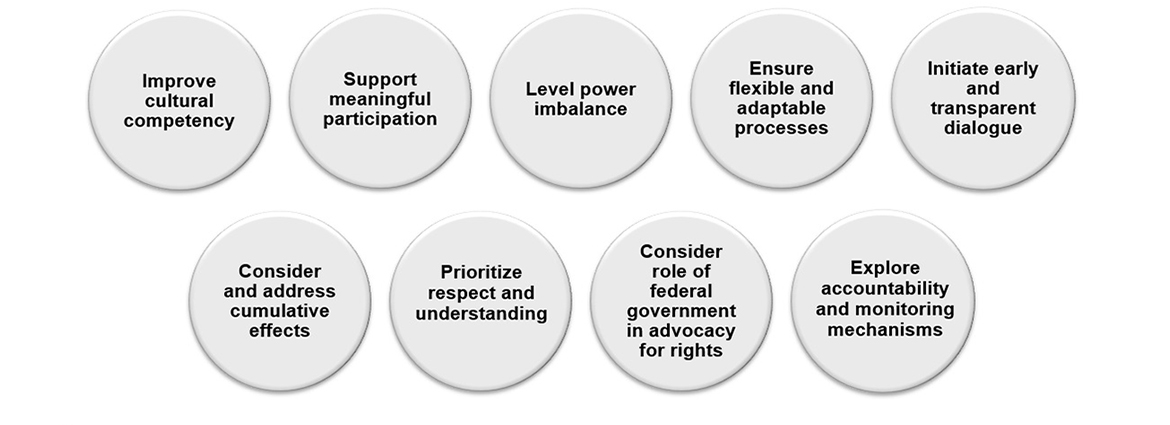
Text alternative for What we learned to date
- Improve cultural competency
- Support meaningful participation
- Level power imbalance
- Ensure flexible and adaptable processes
- Initiate early and transparent dialogue
- Consider and address cumulative effects
- Prioritize respect and understanding
- Consider role of federal government in advocacy for rights
- Explore accountability and monitoring mechanisms
Phase 2
The second phase of regional engagements aimed to present ideas for the proposed content of new guidelines, building on what was learned during Phase 1. It allowed participants to provide feedback on these ideas before the content is drafted and finalized. This phase of engagement is was held from February to December 2025. Virtual sessions were also held for people who could not attend in-person.
What we learned reports
Two "What We Learned Reports" were developed during the process. An Interim Report that captures Phase 1 regional engagement sessions is finalized and is available on request. Please contact indigenous.consultations.autochtones@rcaanc-cirnac.gc.ca to request a copy. The companion report, a high level summary of the Interim Report, is available: 2024 Engagement on the Renewal of the Federal Consultation and Accommodation Guidelines: Companion Interim What We Learned Report. A Final What We Learned Report presenting the Phase 2 regional engagement sessions is available at: 2025 Engagement on the Renewal of the Federal Consultation and Accommodation Guidelines – Final What We Learned Report.
A report covering the key themes of the new guidelines is also available: Federal consultation and accommodations guidelines: key themes report.
Publication
Publication of the renewed guidelines is planned for 2026.
How to participate
The regional engagement for this process is now complete.
When and where
| Date | Location |
|---|---|
| February 27 and 28, 2024 | Whitehorse, Yukon |
| March 12 and 13, 2024 | Edmonton, Alberta |
| March 19 and 21, 2024 | Vancouver, British Columbia |
| April 10, 2024 | Saskatoon, Saskatchewan |
| April 16, 2024 | Winnipeg, Manitoba |
| April 30 and May 1, 2024 | Quebec, Quebec |
| May 14 and 15, 2024 | Halifax, Nova Scotia |
| June 4 and 7, 2024 | Yellowknife, Northwest Territories |
| September 12, 2024 | Virtual session, Lands and Resources Management Boards |
| September 17, 2024 | Toronto, Ontario |
| September 24, 2024 | Virtual session all regions |
| Date | Location |
|---|---|
| February 18, 2025 | Quebec, Quebec |
| February 25, 2025 | Toronto, Ontario |
| February 27, 2025 | Thunder Bay, Ontario |
| March 12, 2025 | Ottawa, Ontario |
| September 16, 2025 | Moncton, New Brunswick |
| September 25 and 26, 2025 | Whitehorse, Yukon |
| October 15, 2025 | French Virtual session, Atlantic, Quebec and Ontario |
| October 16, 2025 | English Virtual session, Atlantic, Quebec and Ontario |
| October 21 and 22, 2025 | Vancouver, British Columbia |
| October 24, 2025 | Prince George, British Columbia |
| November 4 and 5, 2025 | Edmonton, Alberta |
| November 18, 2025 | Winnipeg, Manitoba |
| November 20, 2025 | Saskatoon, Saskatchewan |
| November 25, 2025 | Virtual session, Manitoba, Saskatchewan, Alberta and British Columbia |
| November 27, 2025 | Virtual session, Lands and Resources Management Boards |
| December 2, 2025 | Yellowknife, Northwest Territories |
| December 5, 2025 | Hay River, Northwest Territories |
| December 9, 2025 | Virtual session, Yukon and Northwest Territories |
Contact us
Crown-Indigenous Relations and Northern Affairs Canada
Consultation and Accommodation Unit
Email: indigenous.consultations.autochtones@rcaanc-cirnac.gc.ca
Related links
- 2024 Engagement on the Renewal of the Federal Consultation and Accommodation Guidelines - Companion Interim What We Learned Report
- Aboriginal Consultation and Accommodation - Updated Guidelines for Federal Officials to Fulfill the Duty to Consult - March 2011
- Government of Canada and the duty to consult
- Building Relationships and Advancing Reconciliation through Meaningful Consultation
- Federal consultation and accommodations guidelines: key themes report