2024 Engagement on the Renewal of the Federal Consultation and Accommodation Guidelines: Companion Interim What We Learned Report
On this page
Context
What?
Over the past year, Crown-Indigenous Relations and Northern Affairs Canada (CIRNAC) met with Indigenous communities and organizations to inform the development of new federal guidelines for federal officials to fulfill the Crown’s duty to consult with Indigenous Peoples and accommodate for impacts on their rights. To better understand the perspectives, ideas, and concerns that Indigenous Peoples have about the current approach to consultation and accommodation processes, CIRNAC’s Consultation and Accommodation Unit undertook a series of 18 in-person engagement sessions across 9 regions, as well as 2 virtual sessions.
Why?
Since the publication of the 2011 guidelines, numerous court challenges have underscored the ongoing struggles faced by Indigenous communities in protecting their rights from the impacts of land and resource development. These challenges reflect the need for renewed guidelines to strengthen the relationship between the federal government and Indigenous communities, including through the implementation of the United Nations Declaration on the Rights of Indigenous Peoples Act (UNDA), and the importance of giving federal officials all the necessary information and guidance to adequately consult with Indigenous Peoples. In 2023, the federal budget earmarked $11.4 million over 3 years for CIRNAC to engage with Indigenous communities to explore the development of renewed guidelines to reflect this changing landscape.
How?
From the Spring to Fall of 2024, CIRNAC brought together Indigenous leaders, consultation professionals, and other key voices involved in the consultation and accommodation processes within Indigenous communities to discuss their experiences when it comes to consultation. Feedback from these engagements will inform the development of new federal guidelines for federal officials to fulfil the Crown’s duty to consult Indigenous peoples and accommodate impacts on their rights.
Process flow
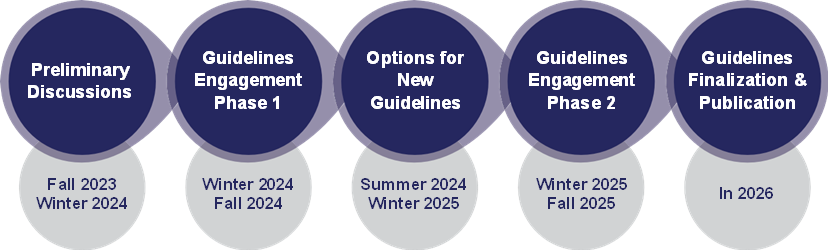
Text alternative for Process flow
5 blue circles describe the stages in the process of the renewal of the Guidelines. 5 grey circles that correspond to the stages show the time period when each step will take place. The first blue circle indicates preliminary discussions, and its grey circle reads Fall 2023-Winter 2024. The second blue circle indicates phase 1 of the guideline’s discussions, and the grey circle reads winter 2024 to fall 2024. The third blue circle indicates the development phase for new guidelines content options and the grey circle reads summer 2024-winter 2025. The fourth blue circle indicates phase 2 of the guideline’s discussions, and its grey circle says winter 2025 to fall 2025. The fifth blue circle indicates the finalization and publication of the guidelines, and the grey circle reads in 2026.
What are the Consultation and Accommodation Guidelines?
The Aboriginal Consultation and Accommodation - Updated Guidelines for Federal Officials to Fulfill the Duty to Consult - March 2011 outline the overarching approach to consultation and accommodation for the Government of Canada.
Government of Canada departments and agencies are responsible for understanding how and when their respective conduct may have adverse impacts on section 35 rights. The Consultation and Accommodation Guidelines guidance and steps for federal officials to following when contemplating actions that may impact on section 35 Aboriginal and/or Treaty rights.
What is the duty to consult?
Canada’s duty to consult is rooted in common law. In 2004, through the Haida and Taku River decisions, followed by the Mikisew Cree decision in 2005, the Supreme Court of Canada established that the Crown has a legal duty to consult and, where necessary, accommodate Indigenous Peoples when considering actions that might adversely impact their rights.
The duty to consult provides an opportunity for the government to make informed and appropriate decisions, create and improve working relationships with Indigenous Peoples, and ensure the protection of section 35 rights of Indigenous Peoples.
The duty to consult and accommodate is a crucial part of federal government conduct. Conduct means projects or activities, including for example, regulatory project approvals, licensing, authorization of permits, and operational decisions. Consultation must occur prior to a decision and implementation of a project or activity.
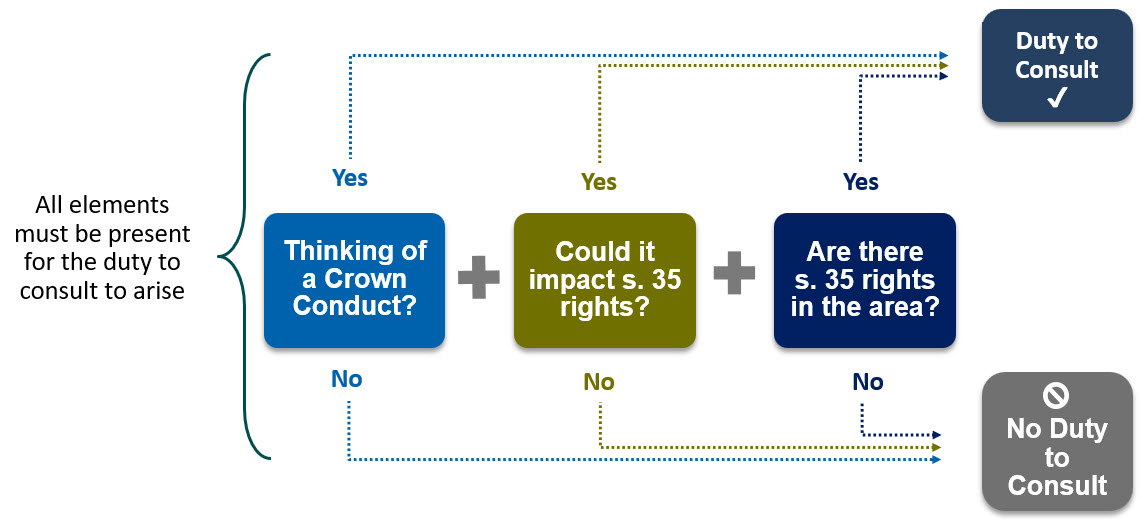
Text alternative for What is the duty to consult?
This flowchart illustrates the decision-making process for determining whether the Crown has a duty to consult Indigenous peoples. It begins with the statement: "All elements must be present for the duty to consult to arise," and then presents 3 key questions: first, "thinking of a Crown conduct?" (blue box), followed by "Could it impact s. 35 rights ?" (green box), and "Are there s.35 rights in the area?" (dark blue box). If the answer to each of these questions is "Yes," an arrow leads to a dark green box labeled "Duty to Consult." If any answer is "No," an arrow leads to a grey box labeled "No Duty to Consult." The flowchart indicates that the duty to consult only applies when all 3 conditions are met.
Who is involved?
CIRNAC’s Consultation and Accommodation Unit (CAU)
Comprised of members from across the country, CIRNAC’s Consultation and Accommodation Unit (CAU) helps provide information, direction, and support to federal officials consulting with Indigenous communities. The CAU is responsible for supporting federal departments and officials in meeting their consultation obligations with Indigenous Peoples. To support this work CAU has been tasked with leading this series of engagements, and it is responsible for the development and implementation of new federal consultation and accommodation guidelines.
Indigenous-Crown Steering Committee
The Indigenous-Crown Steering Committee is a focused group of consultation experts from Indigenous communities and organizations, and from CIRNAC. Members were invited by CIRNAC through Indigenous partners implementing consultation protocols, consultation resource centres stewards, and Indigenous modern treaty and self-government agreement holders. Members were also identified during regional engagement sessions. The Steering Committee plays an advisory role on the renewal of the guidelines by leading on the development of new content with a strong focus on partnerships and Indigenous perspectives; supporting the approach to engagement on new Guidelines; and making recommendations that support effective, meaningful and adaptable processes.
Naut’sa mawt Event Management
In an effort to engage Indigenous communities in a culturally sensitive and respectful manner, CIRNAC has partnered with Naut’sa mawt Resources Group. Naut’sa mawt Resources Group, which includes Naut’sa mawt Event Management and Indigenous Marketing Solutions, is a subsidiary of the Naut’sa mawt Tribal Council, a non-profit society comprised of 10 Coast Salish member Nations. Naut’sa mawt Event Management frequently engages with Indigenous communities across Canada, navigating the unique distinctions between First Nations, Métis, and Inuit groups. It is committed to fostering meaningful, respectful, and culturally informed collaborations to ensure that every event it manages is aligned with the values, traditions, and Protocols of the Indigenous communities it serves. In doing so, Naut’sa mawt Event Management embodies the phrase from which it draws its name: Naut’sa mawt is Hul’q’umin’um’ for "Working Together as One."
Participants
To support this work, CIRNAC invited First Nations, Indigenous Organizations, and Métis communities to 20 engagement sessions held in 9 regions across the country and virtually to learn about consultation and accommodation processes from the perspective of Indigenous communities. Throughout the engagement series, CIRNAC met with 347 individuals from coast-to-coast-to-coast, representing 229 Indigenous communities and organizations.
Who participated
The following map outlines the location of in-person engagement events and the location of participating communities and organizations from Phase 1, including both in-person and virtual sessions.
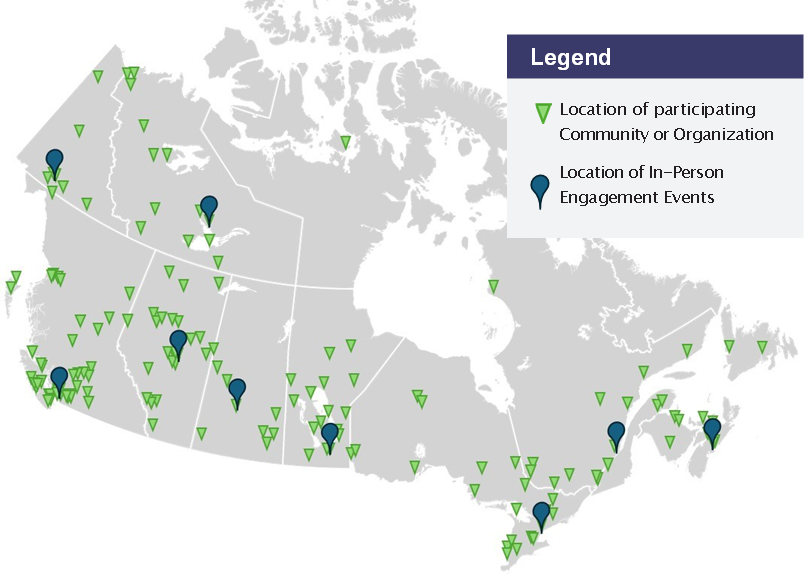
Text alternative for Who participated
Descriptive text : The image is a grey map of Canada showing only the shape and the outline of the provinces and territories. The map shows points in blue showing the location of in-person engagement events and green points with the location of participating communities and organizations from Phase 1, including both in-person and virtual sessions.
The blue dot identifies the location of in-person engagement events:
- Whitehorse, Yukon
- Yellowknife, Northwest Territories
- Vancouver, British Columbia
- Saskatoon, Saskatchewan
- Winnipeg, Manitoba
- Toronto, Ontario
- Quebec City, Quebec
- Halifax, Nova Scotia
Green triangles identify the location of participating communities or organizations:
Yukon Territory:
- Carcross/Tagish First Nation
- Kwanlin Dün First Nation
- Liard First Nation
- Na-cho Nyäk Dun First Nation
- Taku River Tlingit First Nation
- Teslin Tlingit Council
- Vuntut Gwitchin First Nation
- Whitehorse Aboriginal Women's Circle
- Yukon Aboriginal Women's Council
- Yukon Environmental and Socio-economic Assessment Board
- Yukon Heritage Resources Board
- Yukon Land Use Planning Board
Northwest Territories:
- Aklavik Indian Band
- Charter Community of K'asho Got'ine Council
- Dechinta Centre for Research and Learning
- Dehcho First Nations Association
- Déljne Gotine Government
- Dene Nation
- Fort Good Hope Dene Community Council
- Fort Good Hope Métis Land Corporation
- Fort Norman Métis Community
- Fort Resolution Métis Government
- Fort Smith Métis Council
- Gwich’in Renewable Resources Board
- Gwich'in Tribal Council
- Gwichya Gwichin Band
- Hay River Métis Government
- Inuvik Native Band
- K'asho Got'ine (Yamoga Land Corporation)
- Kátł'odeeche Fırst Natıon
- Liidlii Kue First Nation
- Mackenzie Valley Environmental Impact Review Board
- Mackenzie Valley Lands and Water Board
- North Slave Métis Alliance
- Northwest Territory Métis Nation
- Salt River First Nation
- Sambaa K'e First Nation
- Sahtu Dene Council
- Sahtu Secretariat Incorporated
- Tlicho Government
- Tulita Dene Band
- Yamoga Land Corporation
- Wek'eezhii Land and Water Board
- West Point First Nation
- Yellowknives Dene First Nation
Nunavut Territory:
- Nunavut Water Board
Province of British Columbia:
- Ahousaht
- Alliance of BC Modern Treaty Nations
- British Columbia Assembly of First Nations
- British Columbia Métis Federation
- British Columbia Native Women's Association
- Ditidaht
- Doig River First Nation
- Douglas First Nation
- Esk'etemc
- First Nations Summit
- Gitanmaax Band
- Gitlaxt'aamiks Village Government
- Halalt First Nation
- Hagwilget Village
- Homalco First Nation
- Huu-ay-aht First Nation
- Kanaka Bar Indian Band
- Lyackson First Nation
- Maa-nulth Treaty Society
- Mamalilikulla First Nation
- Musqueam Indian Band
- Namgis First Nation
- Native Women's Association of Canada
- Old Massett Village Council
- Penticton Indian Band
- People of the River Referrals Office
- Peters First Nation
- S'ólh Téméxw Stewardship Alliance
- Saik’uz First Nation
- Saulteau First Nations
- Semiahmoo First Nation
- Sik-e-dahk Band
- Simpcw First Nation
- Skeetchestn
- Skidegate
- Takla First Nation
- Tk’emlúps te Secwépemc
- Tla'amin Nation
- Toquaht Nation
- Tsawout First Nation
- Tsawwassen First Nation
- Tseshaht First Nation
- Tsq’escen First Nation
- T’Sou-ke First Nation
- T’it’q’et First Nation
- Uchucklesaht Tribe Government
- Union of British Columbia Indian Chiefs
- Westbank First Nation
- Xaxli’p
Province of Alberta:
- Alexander First Nation
- Athabasca Chipewyan First Nation
- Beaver First Nation
- Bigstone Cree Nation
- Blood Tribe First Nation
- Buffalo Lake Métis Settlement
- Cadotte Lake Métis Nation
- Ermineskin Cree Nation
- Frog Lake First Nation
- Heart Lake First Nation
- Horse Lake First Nation IRC
- Kapawe`no First Nation
- Lac Ste. Anne Métis Community Association
- Little Red River Cree Nation
- Métis Nation of Alberta - Otipemisiwak Métis Government
- Métis Settlements General Council
- Montana First Nation
- Paul First Nation
- Sawridge First Nation
- Stoney Nakoda Nations (MNP LLP)
- Sucker Creek First Nation
- Swan River First Nation
- Tallcree Tribal First Nation
- Tsuut'ina Nation
- Whitefish Lake First Nation
- Woodland Cree First Nation
Province of Manitoba:
- Assembly of Manitoba Chiefs
- Interlake Reserves Tribal Council
- Jackhead First Nation
- Lake Manitoba First Nation
- Little Black River First Nation
- Little Grand Rapids First Nation
- Manitoba Keewatinowi Okimakanak
- Misipawistik Cree Nation
- Norway House Cree Nation
- O'Chiese First Nation Consultation Office
- Opaskwayak Cree Nation
- Peguis First Nation
- Sagkeeng First Nation
- St. Theresa Point Anisininew Nation
- Swan Lake First Nation
- War Lake First Nation
- Wuskwi Sipihk First Nation
Province of Saskatchewan:
- Cote First Nation
- Federation of Sovereign Indigenous Nations
- File Hills Qu’Appelle Tribal Council (Treaty 4 Territory)
- First Nations Capital and Infrastructure Agency of Saskatchewan
- Indigenous Advisory & Monitoring Committee
- Moosomin First Nation
- Nekaneet First Nation
- Onion Lake Cree Nation
- Pheasant Rump Nakota First Nation
- Thunderchild First Nation
- Whitecap Dakota Nation
- Zagime Anishnabek First Nation
Province of Ontario:
- Aamjiwnaang First Nation
- Alderville First Nation
- Animakee Wa Zhing #37
- Anishinabek Nation Government
- B’Maakonigan
- Beaverhouse First Nation
- Brunswick House
- Chiefs of Ontario
- Chiefs of Ontario / First Peoples Law
- Chippewas of Nawash Unceded First Nation
- Chippewas of the Thames First Nation
- Curve Lake First Nation
- Garden River First Nation
- Indigenous Youth Roots
- Kebaowek First Nation
- Kijicho Manito Madaouskarini
- Mississaugas of the Credit First Nation
- Neskantaga First Nation
- Nibinamik First Nation
- Niisaachewan Anishinaabe Nation
- Nishnawbe Aski Nation
- Ontario Native Women's Association
- Six Nations of the Grand River
- Snimikobi Algonquin First Nation
- Three Fires Group / Kettle and Stony Point First Nation
- Walpole Island First Nation / Independent Electricity System Operator
Province of Quebec:
- Algonquin Anishinabeg Nation Tribal Council
- Assembly of Seven Generations
- First Nations of Quebec and Labrador Sustainable Development Institute
- First Nations of Quebec Economic Development Commission
- Huron-Wendat Nation
- Innu Essipit First Nation Council
- Innu Takuaikan Uashat mak Mani-utenam
- Innus of Natashkuan
- Long Point First Nation
- Mi’gmawei Mawio’mi Secretariat
- Micmacs of Gesgapegiag
- Mohawk Council of Kahnawà:ke
- Nunavik Marine Region Planning Commission
- Pekuakamilnuatsh Takuhikan
- W8banaki
Atlantic Provinces:
- Aboriginal Women’s Association of PEI
- Atlantic Policy Congress of First Nations Chiefs Secretariat
- Burchell Wickwire Bryson LLP
- Confederacy of Mainland Mi'kmaq
- Elsipogtog
- Fox LLP
- L'nuey - Epekwitk Assembly of Councils - Mi'kmaq Nation
- Membertou First Nation
- Miawpukek First Nation
- Mi'gmawe'l Tplu'taqnn Incorporated
- Native Council of Prince Edward Island
- Natoaganeg First Nation
- Newfoundland Native Women's Association
- Office of the Regional Chief for Prince Edward Island
- Pictou Landing First Nation
- Wolastoqey Nation
CIRNAC and Naut’sa mawt Event Management would like to extend their sincere appreciation to everyone who participated in Phase 1 of the Engagement on the Renewal of the Federal Consultation and Accommodation Guidelines, from Nations, communities, and organizations from coast-to-coast-to-coast. We acknowledge the experience and expertise that everyone brought to the table and want to thank each and every participant for their time, their input, and for the important feedback that they shared.
Preparing for consultation
Participants were asked how new consultation and accommodation guidelines could help federal officials better prepare for consultation. In particular, participants were asked how the government can support the development of respectful and effective working relationships in a way that could improve future consultation processes.
What we learned
New guidelines should outline the importance of ensuring that federal officials receive appropriate cultural competency training, ideally through a grassroots model that prioritizes lived experience over standardized training courses.
Supports for traditional language speakers and for integrating specialized Indigenous Knowledge into the preparatory stage of consultation is needed to better assess impacts of a development project on the land.
Increasing Indigenous representation within federal departments and forming a group of experienced federal consultation experts would be useful to support federal officials in navigating government’s relationships with communities throughout the consultation process.
Consultation processes should favour an early and more partnership-based approach that prioritizes transparency and a government-to-government approach. Indigenous communities must be involved before a project enters the preparatory phase and consultation is required.
Flexible, multi-year funding agreements with fewer administrative requirements that cover consultation activities more generally and allow for leftover funds to roll over to subsequent years would improve Indigenous People’s participation. Participants recommended keeping funding dollars in community to grow citizens’ professional and technical capacities, instead of relying on outside consultants.
Consultation process
Participants were invited to share feedback around the level of consistency across various consultations, the level of information shared with these consultations, as well as the clarity of the process in general. Participants were also asked what particular challenges they may have had to face in assessing impacts to their rights, how to further integrate considerations for cumulative impacts into the assessment stage, and how to clearly establish a community’s informed consent.
What we learned
Communities must have the flexibility to participate in the assessment of impacts to their rights in a way that accurately captures and reflects their rights, regardless of whether they might be considered "established" or "potential."
Renewed guidelines need to provide greater clarity with regards to the roles and responsibilities of proponents and government – both federal and provincial/territorial government – while ensuring accountability via official enforcement mechanisms, such as an Indigenous regulatory body.
Giving Indigenous communities access to the same experts, consultants, researchers, and lawyers as government can help level the power imbalance that exists between the federal government and Indigenous communities.
Timelines need to allow ample time for Indigenous communities to engage with their members in a way that respects their specific protocols and processes. Timelines must also account for any follow-up assessments that may be required throughout a given project’s lifecycle.
Consultation and accommodation processes need to consider cumulative impacts to rights by considering a project within its broader context, including the environmental, historical, legal, and cultural context of the community in which the project is taking place.
Indigenous communities must be given all the information required for them to provide informed consent, maintain informed consent, and they must have the ability to withdraw consent at any time.
New guidelines should emphasize that neither consultation nor silence equals consent, and that communities shall not be coerced into providing consent.
Determining accommodation measures
Participants were asked for recommendations on how to improve the accommodation measures process, including the determination, implementation, and monitoring of accommodation measures.
What we learned
In consultation and accommodation processes, efforts must first aim to avoid impacts to Indigenous rights altogether, before considering efforts to reduce or mitigate impacts on rights.
Consultation and accommodation go hand in hand, and undertaking consultation does not in and of itself represent an accommodation measure.
Consultation and accommodation should be approached through a government-to-government lens, giving Indigenous communities real power to influence the outcome, while ensuring that Indigenous communities are supported in implementing accommodation measures that involve them, and in monitoring these measures’ effectiveness.
Indigenous communities must always be provided enough clarity with regard to governments and proponents’ roles and responsibilities in matters of accommodation to allow for coordination and to ensure accountability.
New guidelines should consider enforcement or appeal mechanisms for instances where responsibilities are not upheld.
Adequate and meaningful consultation
Participants were asked to explore what adequate and meaningful consultation means to them, and what "acting in good faith" means in the context of consultation. Participants were also invited to share examples of best practices in the current Indigenous-Crown relationship that could inform the development of new guidelines.
What we learned
Time and resources must always be invested to ensure that Indigenous communities have real influence on a project through the consultations and accommodation processes. Consultation is not meaningful if questions, concerns, ideas, and suggestions that communities want to talk about are unaddressed.
Timelines need to be flexible and allow ample time for Indigenous communities to engage with their members in a way that respects community protocols and governance processes. A community’s failure to respond to a consultation request within a certain timeframe must never be interpreted as consent.
Everyone involved in the consultation process, including Indigenous governments, federal and provincial/territorial governments, and project proponents, need to be at the table to ensure a coordinated approach and to reduce redundancies.
New guidelines need to better advocate for respect and for the protection of Indigenous rights, with all levels of government.
Government should consider creating a body or mechanism to ensure accountability throughout the consultation and accommodation process and adherence to guidelines and community-based protocols.
Key takeaways
Funding, capacity and timelines
Greatly expand funding so that communities can grow the in-house capacity needed to meaningfully participate in the consultation process from an early stage and throughout the process in order to protect their rights.
Cultural competency
Improve federal officials’ cultural competencies through on-the-ground learning, moving beyond broad distinctions to more accurately cater to each community’s unique history, culture, governance, and protocols.
Nation-to-Nation collaboration
Consultation and accommodation processes need to better reflect the essence of nation-to-nation collaboration which recognizes that Indigenous Peoples are foundational to Canada’s constitutional framework and are involved in effective governance and decision-making.
Transparency and accountability
Increase transparency around the federal government’s assessment of which Indigenous communities to involve in consultation and what rights that may be impacted. This will lay the foundation for a collaborative approach to determining accommodation measures, with a clear understanding of who is accountable for implementation.
How can I stay involved?
CIRNAC is committed to continuing the discussion on consultation and accommodation guidelines through information sharing and dialogue. Please visit the website for more information about the renewed Federal Consultation and Accommodation Guidelines, updates on the process, and other relevant information. If you would like to connect with the Consultation and Accommodation Unit, please reach out using the following email address.
Email: indigenous.consultations.autochtones@rcaanc-cirnac.gc.ca
Website: Government of Canada and the duty to consult
For information regarding reproduction rights, please contact: communicationspublications@sac-isc.gc.ca
www.canada.ca/crown-indigenous-relations-northern-affairs
1-800-567-9604
TTY only 1-866-553-0554
Catalogue: R118-24/1-2025E-PDF
ISBN: 978-0-660-77900-3
© His Majesty the King in Right of Canada, as represented by the Minister of Crown-Indigenous Relations and Northern Affairs Canada, 2025.
This publication is also available in French under the title: Mobilisation de 2024 sur le renouvellement des lignes directrices fédérales sur la consultation et l'accommodement - Rapport d'accompagnement provisoire sur ce que nous avons appris.