Federal consultation and accommodations guidelines: key themes report
Table of contents
- Purpose of the report
- Introduction
- About the federal consultation and accommodations guidelines
- Engagement process
- Key themes and policy statements
- Conclusion
Purpose of the report
This report explains the key themes of the proposed new Federal Consultation and Accommodation Guidelines. It also presents draft policy statements that will help to shape the Guidelines. Its purpose is to help federal departments and agencies understand the upcoming Guidelines, and support promotional activities before the Guidelines are published.
All information in this report is draft and will be replaced by the final version of the new Guidelines.
Introduction
The Government of Canada consults with First Nations, Inuit, and Métis Peoples when a proposed government action or conduct could negatively impact their rights. This is a legal obligation based on section 35 of the Constitution Act, 1982, which recognizes and affirms the rights of Indigenous Peoples.
The Government of Canada also consults with Canadians on subjects that matter to them. These consultations help gather different views, promote transparency, build trust, and give people a chance to influence decisions.
In the Haida and Taku River decisions (2004), and the Mikisew Cree decision (2005), the Supreme Court of Canada confirmed that the Crown has a duty to consult First Nation, Inuit and Metis Peoples when it considers actions that could negatively impact section 35 rights. This duty also comes from the honour of the Crown, which requires the Crown to act honourably and in good faith towards Indigenous Peoples, and from the Crown's unique relationship with them.
Through meaningful consultation, the Government of Canada works to strengthen relationships with Indigenous Peoples. This approach supports reconciliation, helps fulfill legal obligations, improves decision-making, and ensures that potential impacts are managed responsibly.
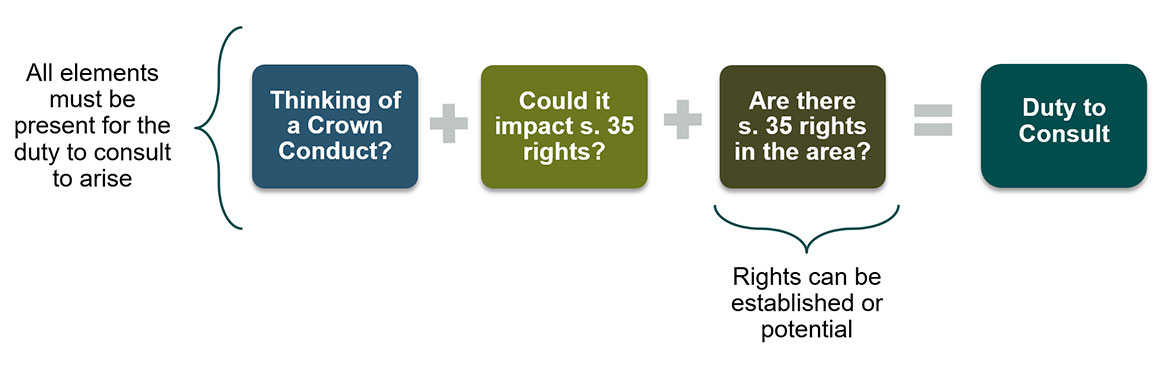
Text alternative for What is the duty to consult?
This flowchart illustrates the decision-making process for determining whether the Crown has a duty to consult Indigenous Peoples.
It begins with the statement: All elements must be present for the duty to consult to arise and then presents 3 key questions:
- thinking of a Crown conduct?
- could it impact s. 35 rights?
- are there s. 35 rights in the area? (Rights can be established or potential)
If the answer to each of these questions is yes, there is a duty to consult.
The duty to consult can be triggered in a wide range of situations. These include:
- project approvals
- development of policies and regulations
- operational decisions
- authorizations
- permits
In some cases, there are also legal obligations to consult that come from laws, contracts, or treaties. These requirements depend on the Indigenous Peoples whose rights may be impacted and how, and on all relevant circumstances of the activity.
Consultation must begin as early as possible during planning, before decisions and approvals are made. Federal departments and agencies are responsible for understanding how their actions could negatively impact section 35 rights.
About the federal consultation and accommodations guidelines
Since 2008, 2 editions of the Federal Consultation and Accommodation Guidelines have explained how the Government of Canada meets its duty to consult and accommodate Indigenous Peoples. The new guidelines will build on this approach.
They are grounded in legal requirements and highlight the importance of meaningful consultation with First Nations, Inuit, and Métis Peoples. The new guidelines will also reflect the Government of Canada's reconciliation commitments, including the Principles respecting the Government of Canada's relationship with Indigenous peoples, and be informed by the United Nations Declaration on the Rights of Indigenous Peoples.
Engagement process
In 2023, Crown-Indigenous Relations and Northern Affairs Canada was mandated to engage with Indigenous groups to update the guidelines. The engagement process unfolded in 2 phases.
The first phase, in 2024, brought together First Nations, Inuit, and Métis leaders, consultation experts, and practitioners. Participants shared their experiences with consultation processes. They highlighted the need for federal officials to have stronger cultural understanding when working with Indigenous Peoples. Participants also called for better collaboration, clearer accountability, and a commitment to long-term relationships.
The second phase took place in 2025. Participants reviewed draft policy statements. They emphasized the importance of early and respectful collaboration, meaningful participation, efficiency, and transparency in shaping the new guidelines.
More than 600 participants from 300 communities and organizations participated in a total of 42 sessions.
Key themes and policy statements
The proposed policy statements reflect the approach needed to move consultation away from a focus on individual projects and towards participation of Indigenous Peoples in decision-making in matters that affect them.
The policy statements outline actions needed to strengthen respect for First Nations, Inuit and Métis Peoples. All policy statements are part of a continuing process. Policy Statement 1: Respecting Section 35 Rights and Assessing the Duty to Consult, serves as the overarching statement. Together, the policy statements aim to ensure consultation processes are respectful and meaningful.
The proposed policy statements are inspired by the guiding principles and consultation directives from the Aboriginal Consultation and Accommodation - Updated Guidelines for Federal Officials to Fulfill the Duty to Consult, updated to reflect what was heard from Indigenous groups across Canada.
The new guidelines will outline the legal considerations and policy recommendations for consultation processes. They will also aim to reflect the perspectives of Indigenous groups and explain what is needed to ensure consultation is meaningful.
Theme 1: Upholding and respecting section 35 rights through meaningful processes
This theme affirms that respecting and upholding section 35 rights is central to all consultation and accommodation processes. It confirms that the Crown is responsible for determining whether proposed actions may impact asserted or established section 35 rights and whether consultation with Indigenous Peoples is required.
The constitutional duty to consult and accommodate can arise when federal action is being considered. The consultation process must be completed before decisions are made or work begins, sometimes with accommodation measures to follow. If there is uncertainty, or a possibility that an action could affect section 35 rights, engagement with Indigenous groups can inform the assessment of the duty to consult.
This assessment is also to be informed by the United Nations Declaration on the Rights of Indigenous Peoples, based on the specific context and circumstances of the proposed action. Obligations related to treaties, self-government agreements, and other section 35 rights-based agreements must also be considered and respected throughout the process.
Given Canada's history, section 35 rights and related interests are often present to some degree. Determining whether the duty to consult applies requires an understanding of section 35 rights, how they relate to a department's activities, and for federal officials to have strong Indigenous cultural competency.
To support self-determination and respect section 35 rights, this theme also emphasizes meaningful processes that allow Indigenous groups to participate in decisions that may impact their rights. These guideposts help build respectful relationships. Since the duty to consult was established, many Supreme Court of Canada and other court decisions have reinforced the need for the Crown to act honourably and in good faith, with the overarching goal of advancing reconciliation.
The elements of meaningful consultation processes are found in court decisions, inspired by government policy and Canada's commitments, and what Indigenous Peoples across Canada have shared through engagement.
Policy statement: Respecting section 35 rights, and assessing the duty to consult
In carrying out its activities, the Government of Canada will respect the potential or established section 35 Aboriginal and treaty rights of First Nations, Inuit, and Métis Peoples through consultation and accommodation where section 35 rights and related interests may be adversely impacted by proposed Government of Canada conduct.
Federal officials must determine, at the outset, whether proposed conduct may adversely impact section 35 rights, and how severely. This preliminary assessment will be informed by the United Nations Declaration on the Rights of Indigenous Peoples.
Where there is doubt about the potential for impacts on section 35 rights, engagement with potentially impacted Indigenous groups is expected to inform this assessment.
Consultation and accommodation processes must be carried out in accordance with applicable legal principles and, where applicable, in alignment with section 35 rights-related agreements made with Indigenous group(s), which can include treaties, modern treaties, self-government agreements, and other relevant agreements.
Policy statement: Meaningful process
A meaningful consultation process is essential to foster relationships with the intention of developing positive outcomes.
A meaningful process includes the following elements:
- carried out in a respectful, timely, efficient, and responsive manner
- flexible, transparent and predictable
- founded in good faith and the honour of the Crown
- respectful of the individuality of Indigenous communities, their way of life, their Indigenous knowledge
- supported by dialogue and information sharing about the conduct and how it will impact section 35 rights, with a view to avoid impacts on rights
- inclusive of accommodation measures and accountability mechanisms for commitments made during the process, in accordance with all relevant circumstances
Theme 2: Building respectful relationships
This theme builds on what Indigenous groups need to take part meaningfully in consultation processes. It outlines steps to help build respect and trust.
It guides federal officials to engage early and to respect Indigenous groups' own processes and governance structures. At the same time, it emphasizes the need to ensure that Indigenous groups have the support they need to participate meaningfully in a process that allows Canada to meet its legal and constitutional obligations.
To build respectful relationships, federal officials are encouraged to communicate with Indigenous groups before a consultation and accommodation process begins. This can be done through planning for a consultation process or informally, depending on the situation and opportunities. This early engagement helps officials learn directly about section 35 rights, cultural protocols, priorities, and values that could be affected by a federal action. When done well, this approach builds trust and understanding and supports stronger collaboration.
The capacity of Indigenous groups varies. As a result, their needs for meaningful participation in consultation and accommodation processes also differ. This makes it important to assess what each group needs to participate effectively. This assessment is expected to be done early to ensure that the Government of Canada can support the participation of Indigenous groups.
Policy statement: Early and ongoing engagement
Engagement between federal officials and potentially impacted Indigenous group(s) is expected to be initiated early and remain ongoing. Early engagement supports mutual understanding and effective consultation and accommodation processes. Ongoing communication ensures proactive and strategic discussions, in a manner that fosters relationships, builds trust, and advances reconciliation.
Policy statement: Facilitating meaningful participation of Indigenous groups
The capacity and resource requirements of potentially impacted Indigenous group(s) to meaningfully participate in a consultation and accommodation process will be considered by federal officials as early as possible.
Federal officials are expected to work to support meaningful participation of potentially impacted Indigenous group(s). In certain contexts, this may include financial capacity support or other tailored options, in accordance with available resources. This work may be done collaboratively with other entities involved in the process.
Theme 3: Free, prior and informed consent and addressing impacts on section 35 rights
The United Nations Declaration on the Rights of Indigenous Peoples is used to help interpret Canadian law, including the duty to consult. The declaration speaks to the importance of involving Indigenous Peoples in decisions that affect their rights and interests through consultation and cooperation. It also highlights situations where the objective of such processes is to seek free, prior, and informed consent. This theme places a focus on seeking free, prior, and informed consent within consultation and accommodation processes in particular circumstances. It also covers the heart of consultation: assessing and avoiding impacts on section 35 rights. They go hand in hand.
The steps in this process emphasize collaboration to avoid impacts on section 35 rights wherever possible. When impacts might be significant and cannot be avoided, appropriate mitigation or other accommodation measures should be developed. If there are still remaining impacts on section 35 rights, compensation may be an appropriate accommodation measure. It always depends on the circumstances.
Building consensus is an important part of the process and must be considered throughout, according to the situation. In particular circumstances, this supports an Indigenous group's ability to provide its free, prior, and informed consent. In other words, identifying potential impacts on section 35 rights, and developing measures to avoid, reduce, or mitigate those impacts, is expected to take place in a timely way to allow Indigenous groups to decide whether to give their consent.
Policy statement: Free, prior and informed consent in consultation and accommodation
Federal officials will work to build and maintain consensus throughout the process, in accordance with all relevant circumstances, with the aim of obtaining free, prior, and informed consent for the proposed federal conduct; as appropriate and informed by the United Nations Declaration on the Rights of Indigenous Peoples.
Policy statement: Assessing impacts on section 35 rights, including cumulative impacts
Federal officials will work to understand the impacts on section 35 rights through an assessment of the potential impacts on section 35 rights of the proposed federal conduct through consultation with potentially impacted Indigenous groups.
The anticipated cumulative impacts of the proposed conduct on section 35 rights and related interests will often be part of this assessment. Federal officials are expected to work to identify cumulative impacts by using a holistic approach that considers the combined potential impacts of the proposed federal conduct on section 35 rights together with past, existing, and foreseeable future activities in the same area, including natural processes (such as floods or wildfires). Where appropriate, collaboration with other levels of government is recommended to inform the assessment of cumulative impacts.
Policy statement: Accommodation measures
Following the assessment of potential impacts on section 35 rights and related interests of conduct, dialogue on accommodation measures is expected in accordance with all relevant circumstances.
This means that federal officials will work with the potentially impacted Indigenous group(s) and, potentially, other participating entities, on the development of appropriate accommodation measures, aiming first to avoid, then reduce, mitigate, or, in some cases, compensate for the adverse impacts on section 35 rights and related interests.
Theme 4: Supporting coordination, efficiency and accountability
This last theme calls on federal departments and agencies to work in a coordinated and efficient way when multiple decisions or authorizations are needed for a single project that all trigger consultation. This includes the ability to rely on information gathered through a consultation process led by another government body and, as applicable, to delegate procedural aspects of consultation and accommodation.
The goal is to avoid having multiple federal departments, or different levels of government, ask the same questions and hold the same discussions with an Indigenous group about the same project. When this situation arises, the new guidelines will recommend identifying a lead department to coordinate consultation activities.
In these cases, it is important that potentially affected Indigenous groups are informed about any reliance or delegation arrangements. Indigenous groups also want to have the opportunity to review and confirm the information and analysis used in decision-making.
To build trust in consultation processes, federal departments and agencies must clearly communicate with impacted Indigenous groups about how information gathered will be used to inform decisions. This approach increases accountability and helps clarify who is responsible for implementing the commitments made during the consultation process.
Policy statement: Delegation and reliance
While the duty to consult and accommodate on federal conduct remains the Government of Canada's responsibility, it may delegate procedural aspects of the process to a third party, which includes provinces, territories, municipalities, private proponents, or similar entities.
As appropriate, the Government of Canada will also rely on information gathered through existing consultation mechanisms to inform consultation, including consultation led through regulatory processes or environmental assessments.
When doing so, federal officials are expected to ensure that potentially impacted Indigenous group(s) are aware that Canada has a duty to consult and are informed of the delegation or reliance approach. In accordance with all relevant circumstances, federal officials are expected to confirm with the respective Indigenous group(s) that information used to inform the process is appropriate, before it is considered as part of the Government of Canada's decision-making.
Policy statement: Coordination, decision-making and accountability
When a consultation process requires the involvement of multiple federal departments or agencies, a lead department or agency will be identified and made responsible for the coordination for that specific process.
The federal department or agency that leads the process is accountable for the consultation and accommodation process and corresponding commitments, or responsible to clearly identify the federal lead that will be accountable after the process, in accordance with all relevant circumstances.
The lead is responsible to communicate the federal department or agency's decision to potentially impacted Indigenous group(s), including the rationale for the decision, along with clearly articulated next steps where there are commitments. The lead federal department or agency is also responsible to maintain ongoing communication.
Conclusion
The insights gained through the engagement process that informed the proposed policy statements will be summarized in a Final What We Learned Report.
The new Federal Consultation and Accommodation Guidelines will provide guidance aimed at ensuring that consultation and accommodation processes uphold the honour of the Crown, advance reconciliation, and respect the section 35 rights and related interests of Indigenous Peoples.
By focusing on respect for section 35 rights, building strong relationships with Indigenous Peoples, and providing guidance on free, prior, and informed consent, the new Guidelines will aim to strengthen consultation and accommodation as meaningful and collaborative processes.