Crown-Indigenous Relations and Northern Affairs Canada's 2026-27 Departmental Plan
On this page
- At a glance
- From the Minister of Crown-Indigenous Relations
- From the Minister of Northern and Arctic Affairs and Minister responsible for the Canadian Northern Economic Development Agency
- Plans to deliver on core responsibilities and internal services
- Department-wide considerations
- Planned spending and human resources
- Supplementary information tables
- Federal tax expenditures
- Corporate information
- Definitions
Copyright information
© His Majesty the King in Right of Canada, as represented by the Minister of Crown-Indigenous Relations and the Minister of Northern and Arctic Affairs and Minister responsible for the Canadian Northern Economic Development Agency, 2026
Catalogue number: R1-106E-PDF
ISSN: 2561-6137
Aussi disponible en français sous le titre : Plan ministériel 2026–2027 de Relations Couronne-Autochtones et Affaires du Nord
At a glance
This departmental plan details Crown-Indigenous Relations and Northern Affairs Canada's (CIRNAC) priorities, plans, and associated costs for the upcoming three fiscal years.
These plans align with the priorities outlined in the Mandate Letter, as well as CIRNAC's Vision, mission, raison d'être and operating context.
Key priorities
CIRNAC identified the following key priorities for 2026–27:
- Renew the Nation-to-Nation, Inuit-Crown, government-to-government relationship between Canada and First Nations, Inuit, Métis and Modern Treaty and Self-Governing partners;
- Affirm and respect Indigenous rights, and support self-determination;
- Lead the Government of Canada's work in the North and Arctic.
Comprehensive Expenditure Review
The government is committed to restraining the growth of day-to-day operational spending to make investments that will grow the economy and benefit Canadians.
As part of meeting this commitment, the department as a whole is planning the following spending reductions:
- 2026–27: $69,300,000
- 2027–28: $69,300,000
- 2028–29: $69,300,000
Further details will be made available upon implementation.
The figures in this departmental plan do not reflect these reductions.
Highlights for CIRNAC in 2026–27
CIRNAC is committed to working together with First Nations, Inuit, and Métis communities, and Modern Treaty Self-Governing partners to support their goals as they take back decision-making over their lands and governance. The United Nations Declaration on the Rights of Indigenous Peoples will continue to guide the work on reconciliation, Indigenous self-determination, and consultation. The department is also committed to improving the quality of life of Northerners and supporting Indigenous-led efforts to grow a strong, prosperous North and Arctic.
In 2026–27, total planned spending (including internal services) for CIRNAC is $11,868,639,770 and total planned full-time equivalent staff (including internal services) is 1,634.
Summary of planned results
The following provides a summary of the results the department plans to achieve in 2026–27 under its main areas of activity, called "core responsibilities."
-
Core responsibility 1: Crown-Indigenous Relations
To support results under Crown-Indigenous Relations, CIRNAC will:
- support the Department of Justice in implementing the United Nations Declaration on the Rights of Indigenous Peoples Act Action Plan;
- support the timely processing of additions to reserve requests and continue working on redesigning the Additions to Reserve Policy;
- support Indigenous groups' capacity to participate in recognition of rights and self-determination discussion tables, and long-term planning and investment cycles;
- continue Specific Claims resolution, as well as the resolution of litigation and the negotiation of settlement agreements;
- advance and implement the Truth and Reconciliation Commission's Calls to Action under CIRNAC's responsibility, and support the interdepartmental coordination of the 76 Calls to Action requiring the federal government's sole or shared leadership;
- collaborate with Indigenous women's and 2SLGBTQI+ organizations, and support initiatives included in the Missing and Murdered Indigenous Women, Girls, and 2SLGBTQQIA+ People National Action Plan;
- support family members and Survivors of missing and murdered Indigenous women, girls, Two-Spirit and gender-diverse people in their healing journey;
- collaborate with Indigenous partners through various engagement mechanisms;
- continue to develop the commitments outlined in Canada's Collaborative Modern Treaty Implementation Policy;
- increase the number of Treaties, agreements and other constructive arrangements that realize self-determination and advance reconciliation, as well as support their management and implementation;
- implement the requirements of the Cabinet Directive on the Federal Approach to Modern Treaty Implementation;
- support the implementation of the Cabinet Directive on the Inuit Nunangat Policy;
- enhance the First Nations Fiscal Management Act regime to enable lending to Indigenous-owned corporations or limited partnerships, known as special purpose vehicles, to ensure it continues to meet the needs of First Nations governments in collaboration with the four First Nations fiscal institutions;
- continue collaborating with First Nations partners to develop a modern solution for land registration and support the development of the First Nations Land Governance Registry;
- work with Indigenous partners to address housing needs and improve the quality of housing within Inuit, Métis and Modern Treaty, Self-Governing communities;
- work with Self-Governing Indigenous governments to implement their education sectoral agreements, and continue to advance collaborative work to define the gap in other critical areas, such as infrastructure, land and resources, and Indigenous languages programming.
- Planned spending: $10,505,939,108
- Planned human resources: 769
More information about Crown-Indigenous Relations can be found in the full plan.
-
Core responsibility 2: Northern and Arctic Affairs
To support results under Northern and Arctic Affairs, CIRNAC will:
- continue discussions with partners to advance the Arctic and Northern Policy Framework by aligning federal investments with partner-identified priorities;
- assess and advance solutions to respond to Canada's critical housing needs in the North;
- advance the implementation of the Nunavut lands and resources devolution;
- continue to invest in northern post-secondary education, research capacity and monitoring, and land based education learning opportunities;
- engage Northerners and scientists in research and monitoring related to long-range contaminants and emerging environmental pressures;
- support food security and sovereignty in isolated and northern communities;
- help northern and Indigenous communities transition from diesel to clean, renewable and reliable energy;
- support climate change adaptation projects and climate monitoring projects;
- manage and advance the remediation of approximately 150 northern contaminated sites, including major mine remediation projects;
- promote the northern and Arctic resources economy while protecting the environment through land-use planning, impact assessment, water licensing, and conservation initiatives;
- advance northern regulatory processes under the Canadian Critical Minerals Strategy, supporting community and regulatory system readiness for major projects;
- work with partners to conduct marine research, harvest studies, and environmental monitoring to strengthen northern knowledge systems and support sustainable resource use.
- Planned spending: $1,207,136,650
- Planned human resources: 373
More information about Northern and Arctic Affairs can be found in the full plan.
For complete information on CIRNAC's total planned spending and human resources, read the Planned spending and human resources section of the full plan.
From the Minister of Crown-Indigenous Relations

The Honourable Rebecca Alty, P.C., M.P.
Minister of Crown-Indigenous Relations
I am pleased to share our 2026–27 Departmental Plan at such a critical time in Canada's history. Since the election, I've listened to First Nations, Inuit, Métis, and Modern-Treaty and Self-Governing partners. Their priorities guide this plan.
We are at a moment that demands urgency and action. Communities are facing a number of challenges and pressures, from infrastructure and housing to jobs and the economy. Although some priorities differ from community to community, the message I hear is consistent and clear: we need to act faster. Our success depends on stronger partnerships, respect for rights, and listening to the people impacted by the decisions we make.
Building on Canada's commitment to the United Nations Declaration on the Rights of Indigenous Peoples, the Government is Building Canada Strong in partnership with Indigenous governments. In Budget 2025, we are empowering Indigenous communities with tools and resources so that they can exercise real control over their lands, their resources, and their futures.
Over three years, we are investing $10.1 million to expand the Federal Initiative on Consultation. We will add three new Indigenous-led resource centres, continue to work with communities on consultation guidelines, and provide the support they need to take part in important decisions that affect their communities.
Bringing land back to First Nations more quickly is a top priority. Through a reformed Additions to Reserve process, Nations can create economic development and address their housing, commercial and other needs. For example, in October 2025, Canada and the Snuneymuxw First Nation announced the addition of nearly 195 acres of federal land in Nanaimo, British Columbia, to the Nation's reserve, enabling mixed-use development plans that include housing, commercial spaces, and other economic opportunities.
The Government of Canada is working together with First Nations, Inuit, Métis, and Modern Treaty and Self-Governing First Nations, Indigenous northern partners and territorial governments by delivering direct investments to partners to address housing needs by increasing housing supply, reducing overcrowding and homelessness, improving housing conditions, and strengthening community supports. Through Build Canada Homes, we will also allocate the remaining $2.8 billion for the Urban, Rural, and Northern Housing Strategy, including collaborating with the Nunavut Housing Corporation and Nunavut Tunngavik Incorporated to build more than 750 public, affordable, and supportive housing units in Nunavut.
In the year ahead, our main work is to recognize and support Section 35 rights, with the goal of cutting red tape and making it easier for Indigenous governments to manage their affairs. This past year, several Modern Treaties and Self-Government agreements were ratified and are now in the final stages of the process. This includes, for example, the Self-Government Treaty we developed in partnership with the Manitoba Métis Federation.
I also understand the importance of settling longstanding historic injustices as a foundation for our future relationship with Section 35 rights-holders. I was pleased to celebrate the settlement with James Smith Cree Nation, along with other recent settlements, such as with Flying Dust First Nation. Negotiated settlements help to right past wrongs, renew relationships, and advance reconciliation for the benefit of all Canadians. These claims can also provide First Nations with the capital to advance on economic development initiatives or invest in new opportunities for communities which can benefit First Nations for generations to come.
Protecting Indigenous women, girls, and 2SLGBTQI+ People remains critical. The voices of Survivors, families, and Indigenous organizations will continue to guide our work as we address the crisis of Missing and Murdered Indigenous Women, Girls and 2SLGBTQI+ People. We will continue funding Indigenous-led projects, like the Indigenous-led Data Research Projects Program, which improves data on missing and murdered Indigenous women, girls, and 2SLGBTQI+ people. This work strengthens evidence, supports prevention, and informs action.
This plan reflects what we value most: partnership, accountability, and results. However, most importantly, it puts those values into action by advancing priorities set by Indigenous Peoples.
The Honourable Rebecca Alty, P.C., M.P.
Minister of Crown-Indigenous Relations
From the Minister of Northern and Arctic Affairs and Minister responsible for the Canadian Northern Economic Development Agency

The Honourable Rebecca Chartrand, P.C., M.P.
Minister of Northern and Arctic Affairs and Minister responsible for the Canadian Northern Economic Development Agency
Life in the North and Arctic has always been shaped by a deep connection to the land, strong communities, and enduring cultures. That foundation remains constant even as the strategic environment around the North is changing rapidly.
Northern and Arctic communities are now at the centre of national and global attention. Decisions taken in the coming years will shape Canada's sovereignty posture, economic resilience, and security architecture for decades. Human security underpins national security in the North. There is no enduring Canadian sovereignty without resilient communities, reliable infrastructure, and sustainable economic opportunity across Northern and Arctic regions.
As the Government advances the Defence Industrial Strategy and strengthens Arctic security, Northern and Arctic Affairs will contribute through disciplined, coordinated delivery. This requires alignment across departments and sustained partnership with Indigenous, Inuit, First Nations, municipal, provincial, and territorial governments. Meeting this moment responsibly requires improving how nationally significant Northern and Arctic infrastructure advances from proposal to regulatory review. Speed without stabilization increases risk.
In 2026–27, the department will strengthen pre-regulatory alignment by clarifying governance frameworks, consultation sequencing, Indigenous participation readiness, and long-term operations and maintenance sustainability before projects enter formal review. This approach reduces litigation exposure, stabilizes timelines, and improves capital confidence while respecting Treaty-based co-management systems.
Northern communities continue to face rising costs, climate pressures, and infrastructure gaps that require coordinated and predictable action. A key priority this year is strengthening Nutrition North Canada to better respond to affordability pressures. The program will continue to address food costs while supporting broader efforts to strengthen food security and sustainable local food systems in partnership with Northern and Indigenous communities.
In March 2026, the department will convene Northern and Indigenous partners, stakeholders, and leaders to identify actionable measures to advance food security and food sovereignty across the North. In 2026–27, we will continue working with the Government of Nunavut and Nunavut Tunngavik Incorporated to implement the Nunavut Lands and Resources Devolution Agreement by April 1, 2027. This milestone advances Inuit leadership in resource management and brings decision-making closer to communities.
Across the North, Indigenous communities are advancing clean energy solutions while adapting to a changing climate. The department will support initiatives that improve energy reliability, reduce diesel dependence, and strengthen climate resilience to protect homes, infrastructure, and harvesting routes.
The 2026–27 Departmental Plan sets a clear course for disciplined execution — strengthening community resilience while improving regulatory readiness for strategic infrastructure. Through coordinated delivery and sustained partnership, we will support a Northern and Arctic future that is stable, secure, and economically strong for generations to come.
The Honourable Rebecca Chartrand, P.C., M.P.
Minister of Northern and Arctic Affairs and Minister responsible for the Canadian Northern Economic Development Agency
Plans to deliver on core responsibilities and internal services
Core responsibilities and internal services
Core responsibility 1: Crown-Indigenous Relations
In this section
Description
Strengthening Crown-Indigenous relationships based on respect by engaging in collaborative initiatives, forming meaningful partnerships, and actively affirming and implementing Indigenous rights and Treaties, through a whole-of-government approach, which will foster reconciliation and advance self-determination.
Quality of life impacts
This core responsibility contributes to the "Good Governance" domain of the Quality of Life Framework for Canada and, more specifically, to "Indigenous Self-Determination" and "Discrimination and Unfair Treatment", through all the activities mentioned in the core responsibility description.
Indicators, results and targets
This section presents details on the department's indicators, the actual results from the three most recently reported fiscal years, the targets and target dates for Crown-Indigenous Relations. Details are presented by departmental result.
Table 1: Nation-to-Nation, Inuit-Crown, government-to-government relationships are renewed
Table 1 provides a summary of the target and actual results for each indicator associated with the results under Crown-Indigenous Relations.
| Departmental Result Indicators | Actual Results | 2026–27 Target | Date to achieve target |
|---|---|---|---|
| Cumulative number of specific claims resolved since the Program's inception in 1973 |
|
806 | March 31, 2027 |
| Percentage of former residential schools for which investigation work has been conducted |
|
86% | March 31, 2027 |
| Percentage of First Nations, Inuit, and Métis partners participating in Crown-Indigenous engagement mechanisms |
|
80% | March 31, 2027 |
| Percentage of Modern Treaty and Self–Governing partners participating in the Intergovernmental Leaders' Forum |
|
90% | March 31, 2027 |
Table 2: Indigenous Peoples exercise self-determination
Table 2 provides a summary of the target and actual results for each indicator associated with the results under Crown-Indigenous Relations.
| Departmental Result Indicators | Actual Results | 2026–27 Target | Date to achieve target |
|---|---|---|---|
| Percentage of First Nations that assert jurisdiction over fiscal management |
|
68% | March 31, 2027 |
| Percentage of First Nations that assert jurisdiction over land management |
|
22% | March 31, 2027 |
| Number of Treaties, Self-Government agreements and other constructive arrangements that have been concluded |
|
105 | March 31, 2027 |
Additional information on the detailed results and performance information for CIRNAC's program inventory is available on GC InfoBase.
Plans to achieve results
The following section describes the planned results for Crown-Indigenous Relations in 2026–27.
Nation-to-Nation, Inuit-Crown, government-to-government relationships are renewed
The renewal of Nation-to-Nation, Inuit-Crown, and government-to-government relationships reflects Canada's commitment to respectful and equal partnerships with Indigenous Peoples. This supports the redress of past and ongoing injustices, focuses on Indigenous voices in decision-making, and is rooted in mutual recognition, accountability, and collaboration.
Results we plan to achieve
Renewing relationships begins with addressing long-standing grievances through fair, negotiated resolutions. Specific Claims address past wrongs against First Nations and settlements can support First Nations to invest in their communities and pursue economic development. The Government of Canada works with First Nations to resolve outstanding Specific Claims primarily through negotiated settlements. CIRNAC has a target of resolving 35 Specific Claims in 2026–27 and aims to meet its 100% target for complying with the legislated timeline under the Specific Claims Tribunal Act, which allows up to three years for completing claims assessments. CIRNAC will continue exploring options for operational improvements that further align the Specific Claims resolution process with the United Nations Declaration (UN Declaration) on the Rights of Indigenous Peoples. The department will also continue to gather First Nations perspectives on the process and learn about the impacts of settlements on communities through voluntary feedback from First Nations.
Strengthening relationships includes fair, negotiated resolutions and litigation practices that reflect partnership, respect rights, and build confidence. CIRNAC partners with the Department of Justice to manage the resolution of litigation, including negotiating settlement agreements out of court or supporting litigation through the court system, in accordance with the Attorney General of Canada's Directive on Civil Litigation Involving Indigenous Peoples, taking into consideration the UN Declaration and helping to establish Canada's Indigenous jurisprudence. As per the Directive and the 10 Principles respecting the Government of Canada's relationship with Indigenous Peoples, wherever possible, CIRNAC prioritizes the resolution of litigation cases through negotiation and settlement to promote reconciliation.
Rebuilding trust also means resolving childhood claims in ways that support healing and community well-being. Canada is committed to resolving Indigenous childhood claims litigation outside of the courts, wherever possible. Settlements are designed to balance individual compensation with forward-looking investments to support healing, wellness, education, language, culture and commemoration.
Renewing relationships also requires sustained, Survivor-centred work that advances truth, healing, and transparency. All of the Truth and Reconciliation Commission's 94 Calls to Action aim to reduce inequality and close socio-economic gaps. The Government of Canada has been working towards full implementation of the 76 Truth and Reconciliation Commission Calls to Action requiring the federal government's sole or shared leadership. In 2026–27, CIRNAC will continue to support whole-of-government efforts towards the implementation of these Calls to Action, working collaboratively with Indigenous Peoples, communities, and partners to drive meaningful progress. Additionally, CIRNAC will work closely with the newly established National Council for Reconciliation (Call to Action 53) – an independent, Indigenous-led body – to support its mandate to advance reconciliation, monitor progress on the Calls to Action, and identify emerging opportunities for collaboration.
Deepening relationships is supported by transparent, Survivor-informed access to information. In 2026–27, CIRNAC will continue to implement Calls to Action 72 to 76 regarding Missing Children and Burial Information. More specifically, the department will continue to support and collaborate with the National Centre for Truth and Reconciliation (NCTR) to update and maintain the National Residential School Student Death Register (Call to Action 72), and develop and maintain the National Residential School Cemetery Register (Call to Action 73). This includes providing stable, predictable funding over two years to the NCTR to ensure it can successfully perform its mandate. This ongoing work will increase the information available to families and Survivors of missing or deceased children from former residential schools.
Moreover, to advance Calls to Action 74 to 76, CIRNAC will continue supporting community-led initiatives centered on the needs of Survivors to locate, document, and memorialize undocumented burial sites and graves associated with the 140 residential schools included in the Indian Residential Schools Settlement Agreement (IRSSA) and the five residential schools included in the Newfoundland and Labrador Residential Schools Settlement Agreement (Anderson). This will include supporting initiatives to honour families' wishes to identify and repatriate children's remains through the Residential Schools Missing Children Community Support Fund in a stable manner over the next two years. To inform the program redesign, CIRNAC will undertake an evaluation of the program and deepen its engagement with Survivors and Indigenous communities.
Strengthening relationships is further supported by coordinated efforts with families, Survivors, and Indigenous partners to address the Missing and Murdered Indigenous Women and Girls (MMIWG) crisis. In 2026–27, the federal government will continue to track progress in advancing its contribution to the Missing and Murdered Indigenous Women, Girls and 2SLGBTQQIA+ People National Action Plan through the Federal Pathway to Address Missing and Murdered Indigenous Women, Girls and 2SLGBTQQIA+ People, Annual Progress Report. This will include efforts to find efficiencies in the reporting process, identify gaps in actions to advance the Calls for Justice, and ensure that information on federal progress to advance the Calls for Justice is detailed, distinctions-based, transparent about funding, and broadly accessible and relevant to families and Survivors.
Building on previous successful collaboration with Indigenous partners and provincial and territorial governments, in 2026–27, CIRNAC will host the 2027 National Indigenous-Federal-Provincial-Territorial (IFPT) Meeting on MMIWG and 2SLGBTQI+ People. The IFPT serves as a mechanism to support important dialogue between national and regional Indigenous organizations, families, Survivors, and government leaders to sustain momentum to address the crisis of MMIWG and 2SLGBTQI+ People. Also, building on the final report on the engagement led by Giganawenimaanaanig to co-develop a regional Red Dress Alert System with Indigenous partners, CIRNAC will advance further collaboration with Giganawenimaanaanig, the Province of Manitoba and other partners through 2026–27. Multi-year projects will also continue to receive funding this fiscal year under the Indigenous-Led Data Research Projects Program, which aims to improve data methodologies specific to MMIWG and 2SLGBTQI+ People.
CIRNAC is committed to supporting family members and Survivors of MMIWG and 2SLGBTQI+ people in finding healing in whatever form is meaningful to them. Projects will continue to receive funding through 2026–27 under the Support for the Wellbeing of Families and Survivors of Missing and Murdered Indigenous Women, Girls and 2SLGBTQQIA+ People Contribution Program. This program supports Indigenous-led, trauma-informed, culturally relevant resources that are accessible to family members and Survivors.
Furthermore, in 2026–27, through the Indigenous Women's and 2SLGBTQI+ program, CIRNAC will support projects focused on community engagement, leadership development, governance, community-driven research, and priority-setting, while reducing administrative burden through streamlined reporting. Aligned with the UN Declaration Act Action Plan (Measure 70), the Calls for Justice, and Sustainable Development Goals (SDGs) 5 and 10, the program supports the social, economic, and civic participation of Indigenous women and 2SLGBTQI+ People and strengthens their leadership in decision-making.
Partnerships with Indigenous women's organizations help integrate gender-based and culturally informed perspectives in federal policy. The department will continue to collaborate with national and regional Indigenous women's organizations to implement the whole-of-government relationship agreements and advance shared priorities. In 2026–27, CIRNAC will advance this work consistent with the UN Declaration, SDG 5.5 (women's leadership in decision-making), and Call for Justice 18.1 (addressing systemic social, economic, and political marginalization). The department will support results-focused initiatives that strengthen Indigenous women's leadership and influence in federal decision-making (UN Declaration Act Action Plan Measure 69). This includes supporting research, engagement, and leadership activities; coordinating federal engagement on economic inclusion, safety, and gendered inequalities; and strengthening mechanisms that enable Indigenous women's organizations to inform federal policy, program, and legislative processes.
Distinctions-based tables provide predictable venues to set priorities and co-develop policy together. In 2017, Permanent Bilateral Mechanisms (PBMs) were established with leaders of the Assembly of First Nations (AFN), Inuit Tapiriit Kanatami (ITK) and the four Inuit Treaty Organizations, and the Métis National Council (MNC) and its then governing members, to identify joint priorities, co-develop policies, and monitor progress. CIRNAC remains committed to strengthening Crown-Indigenous relationships with First Nations, Inuit, and Métis partners through distinctions-based fora.
Through the Inuit-Crown Partnership Committee, CIRNAC will continue working with Inuit leaders to address complex, cross-cutting issues and advance transformational change based on Inuit self-determined priorities for Inuit Nunangat. In collaboration with First Nations and Métis leadership, CIRNAC will build on lessons learned to evolve the existing bilateral structures by developing new approaches that support these relationships in ways that are responsive to how partners want to engage with the federal government going forward.
Regular engagement among Indigenous, federal, and territorial leaders sustains momentum and resolves issues across governments. The Intergovernmental Leaders' Forum remains a permanent annual forum bringing together the Prime Minister, relevant Ministers, and leaders of Modern Treaty and Self-Governing Indigenous governments for direct conversations on significant matters of concern. CIRNAC will continue to work with Modern Treaty and Self-Governing partners to advance priorities through this forum.
Strong relationships with Indigenous partners require consistent, rights-respecting consultation across government. CIRNAC will continue to support the whole-of-government approach to consultation and accommodation through enhanced guidance and interdepartmental coordination to help ensure the Crown meets its constitutional obligations, as well as its commitments under the UN Declaration and the UN Declaration Act.
Advancing these relationships requires clear guidance and practical tools that support meaningful consultation on decisions that may affect rights. The Government of Canada has a duty to consult and, where appropriate, accommodate Indigenous groups when it contemplates actions that might negatively impact Aboriginal or Treaty rights. CIRNAC will continue to support this whole-of-government approach to ensure the Crown fulfills its constitutional obligations and commitments under the Building Canada Act, UN Declaration, and the United Nations Declaration Act. The department will continue to advance whole-of-government policy initiatives and provide advice on major project assessments, including projects of national interest, by providing guidance, advice, and tools to support federal officials in other departments, including the Major Projects Office, to undertake meaningful consultation, accommodation, and engagement.
Budget 2023 provided funding for CIRNAC to engage with Indigenous groups and renew the guidelines for federal officials to fulfill the Crown's Duty to Consult and Accommodate. Renewing these guidelines in partnership with Indigenous Peoples is essential to adequately equip federal officials to work meaningfully with Indigenous communities. The first phase of regional engagements were held from February 2024 to September 2025. A second phase began at the end of 2024–25 and continued throughout 2025–26. The new guidelines will be finalized and launched in 2026–27.
CIRNAC remains committed to partnering with Indigenous Peoples through the co-development and implementation of consultation protocol agreements and consultation resource centres. These initiatives create clear processes for federal departments to follow when consulting on potential adverse impacts to established or asserted Aboriginal or Treaty rights and provide much-needed capacity supports for Indigenous groups to respond to consultation requests. Currently, CIRNAC is funding the implementation of 13 consultation protocols (supporting 41 First Nations and nine Métis collectives) and co-developing five new protocols (representing 15 First Nation communities and one self-identified Indigenous community asserting Indigenous rights). CIRNAC also funds five consultation resource centres.
The department will continue to ensure that Indigenous rights and interests are known to federal officials by making regular system enhancements and content updates to the Aboriginal and Treaty Rights Information System (ATRIS). These updates facilitate information sharing in support of consultation, including for major projects, and will include co-developing system content with Indigenous partners where appropriate. CIRNAC will also explore options to modernize ATRIS to better support whole-of-government efficiency and keep pace with the growing complexity of Indigenous consultation.
In 2026–27, CIRNAC will continue fostering renewed Nation-to-Nation, Inuit-Crown, and government-to-government relationships with Indigenous partners who hold Modern Treaties, stand-alone Self-Government arrangements, sectoral agreements, and board-type organizations. By maintaining collaborative relationships with Indigenous partners, the department will support Indigenous-led initiatives to rebuild and reconstitute their historic nations, advance self-determination, and reduce socio-economic gaps between Indigenous and non-Indigenous peoples. The department will aim to ensure that all public government institutions and Modern Treaty partners have access to stable and ongoing funding for their programs and services.
Deepening these relationships includes joint work on jurisdiction and service arrangements that reflect partners' priorities. The department will also continue strengthening relationships with Indigenous partners and supporting Indigenous rights to self-determination through negotiating amendments to existing Modern Treaty and Self-Government agreements. CIRNAC will continue exploratory and preliminary discussions with partners in the Northwest Territories to assume responsibility for education, including early childhood education. Within the same region, the department will continue to advance and negotiate the renewal of the Intergovernmental Services Agreement with the Tłı̨chǫ Government.
To support the management of Modern Treaties and Self-Government agreements, CIRNAC will also continue to engage with partners to draft and renew implementation plans, which set a common understanding for how parties will implement final and Self-Government agreements. These discussions will be held with different partners across Canada. The department will continue its work to support Indigenous partners in assuming responsibilities for programs and services.
This fiscal year, CIRNAC will continue to implement the renewed Nunavut Agreement Implementation Contract (2024–34), which provides a 10-year funding framework to implement the commitments made under the Nunavut Agreement. This includes historic investments of $1.5B from 2024 to 2034 and $77.6M annually in ongoing funding. This funding will support Nunavut Tunngavik Incorporated, the Government of Nunavut, the five Institutions of Public Government (including three Regional Wildlife Organizations and 27 Hunters and Trappers Organizations), and Pilimmaksaivik, the Federal Centre of Excellence for Inuit Employment in Nunavut.
Indigenous Peoples exercise self-determination
The affirmation and implementation of Indigenous Peoples' inherent right to self-determination, including the right to Self-Government, is essential for promoting reconciliation and empowering Indigenous communities to shape their own social, economic and political development, thereby contributing to an equitable and sustainable society.
Results we plan to achieve
UN Declaration–aligned measures advance self-determination across social, economic, and cultural priorities. CIRNAC will continue to make progress in implementing the UN Declaration Act Action Plan (2023-2028) measures which it leads. According to the UN Declaration, Indigenous Peoples have the right "to the improvement of their economic and social conditions, including, among other things, in the areas of education, employment, vocational training and retraining, housing, sanitation, health and social security".
Advancing self-determination begins with rights-based negotiations that recognize Indigenous jurisdiction and reflect community priorities. Modern Treaties, Self-Government agreements and other constructive arrangements are the foundations for transformative change that move us away from colonial systems of administration and governance. These agreements advance Indigenous political, economic, and cultural development while providing increased predictability over lands and natural resources necessary to transform the Canadian economy. In 2026–27, CIRNAC will continue to advance section 35 rights-based discussions that lead to substantive agreements addressing the needs, interests, and priorities of Indigenous partners.
CIRNAC will work in partnership with historical (pre-1975) Treaty First Nations through the offices of the Treaty Commissions in Saskatchewan and Manitoba to review and support historic Treaty relationships. In British Columbia, successful community ratification votes were held for the K'ómoks, Kitselas, and Kitsumkalum Modern Treaties. The next steps include ratification of the three Modern Treaties by the Government of British Columbia and the Government of Canada. Signing of these Modern Treaties is targeted for 2026–27, followed by the federal legislative process. In the North, two Modern Treaties and a related binding agreement are anticipated to be signed. Once in effect, these agreements will constitutionally protect certain First Nation and Inuit rights with respect to harvesting, land ownership, and resource management in the Northwest Territories, Nunavut, and northern Manitoba.
A rights-based negotiation framework helps clarify jurisdiction, ownership, and recognition of Indigenous-owned lands, supporting self-determination. The Recognition and Reconciliation of Rights Policy for Treaty Negotiations in British Columbia supports a rights-based approach to the negotiation of Treaties, agreements and other constructive arrangements among Canada, British Columbia and participating Indigenous nations in British Columbia. In 2026–27, CIRNAC will continue to implement the policy in partnership with the other principals to the British Columbia Treaty process (the First Nations Summit and the Province of British Columbia). The parties will continue to advance the development of an annex, as outlined in Schedule A of the Policy (Commitments to Further Work) pertaining to the jurisdiction, form of ownership, and constitutional status of Indigenous-owned lands.
Clear implementation processes help integrate self-determination into federal decisions. The purpose of Canada's Collaborative Modern Treaty Implementation Policy, released in 2023, is to increase understanding and awareness of the importance of the implementation of Modern Treaties, with the specific goal of advancing a systemic shift in the federal public service's institutional culture, reflected in behaviour, decision-making, and actions at every level of the federal government. Additionally, the policy's key principles will guide federal officials in upholding the spirit and intent of Modern Treaties and provide clear direction to deputy heads on their responsibilities for overseeing implementation. In 2026–27, collaborative work will continue to focus on priorities set by the Modern Treaty Implementation Policy Working Group in March 2023: revising the Cabinet Directive on the Federal Approach to Modern Treaty Implementation and improving dispute resolution processes. The department will continue to support Bill C-10 (An Act respecting the Commissioner for Modern Treaty Implementation), introduced by the Minister of Crown-Indigenous Relations in September 2025, as it continues to be considered in Parliament.
In parallel, CIRNAC is working with Indigenous Modern Treaty partners and more than 45 federal departments and agencies to co-develop an updated Cabinet Directive on the Federal Approach to Modern Treaty Implementation. This work responds to issues identified through evaluations and partner feedback and will better align the directive with Canada's Collaborative Modern Treaty Implementation Policy, commitments under the UN Declaration Act Action Plan, and related federal priorities focused on Treaty evolution, sustainable implementation, and improved outcomes for Indigenous Modern Treaty partners. Drafting the updated Cabinet Directive is underway, but requires continued engagement with Indigenous and federal partners to review specific provisions, operational expectations, and supporting tools. CIRNAC will solicit proposals through an annual call for proposals to support projects that advance Modern Treaty and Self-Government agreement implementation.
CIRNAC will also continue its work on the Collaborative Fiscal Policy Development Process, a whole-of-government initiative involving federal officials and representatives of 30 Self-Governing Indigenous governments to co-develop expenditure need methodologies and approaches as set out in Canada's Collaborative Self-Government Fiscal Policy.
Stronger fiscal and infrastructure institutions increase access to capital and expand Indigenous jurisdiction. The First Nations Fiscal Management Act provides First Nations with a legislative and institutional framework through which to assert and exercise jurisdiction in the areas of financial management, taxation, and access to capital markets and more recently, respecting the provision of services and infrastructure. In 2026–27, the department will continue to co-develop amendments to the First Nations Fiscal Management Act to enhance access to the pooled borrowing regime for Indigenous corporations, limited partnerships, and non-profit organizations. Facilitating access to the pooled borrowing regime for Self-Governing First Nations; and supporting enhancements to Indigenous tax jurisdiction frameworks are key priorities of Indigenous partners.
Budget 2025 announced the government's intention to explore the creation of new infrastructure financing tools and expand the options available to communities to deliver critical infrastructure. Canada also committed to further enhance access to capital for Indigenous groups seeking equity participation in economic and resource development projects. In 2026–27, the department and the First Nations Finance Authority will continue to work on policy co-development related to proposed amendments to the First Nations Fiscal Management Act to enable lending to Indigenous-owned corporations or limited partnerships, known as special purpose vehicles. CIRNAC will also work with Indigenous Services Canada (ISC) to support exploratory pilots enabling on-reserve construction companies to bid for infrastructure projects and First Nations to monetize federal transfers to secure financing for infrastructure.
Robust land governance frameworks led by First Nations support local decision-making. The Framework Agreement on First Nation Land Management enables participating communities to withdraw their lands from the land management provisions of the Indian Act, and to implement First Nation governance and laws with respect to their land, resources and environment. Continuing work on the commitment made in Budget 2023 to support the development of a First Nation-led land registry system, CIRNAC has been working closely with the Lands Advisory Board and the First Nations Land Management Resource Centre to develop the First Nation Land Governance Registry. This registry will be managed and administered by the new not-for-profit First Nation Land Governance Registry Incorporated to support registry and land management for First Nations with operational land codes pursuant to the Framework Agreement on First Nation Land Management, as well as any Self-Governing First Nation with section 91(24) lands that chooses to use it for land registration.
CIRNAC will continue collaborating with First Nation partners to complete the development of this modern registry solution for land management. Further funding and authorities will be sought to begin phased implementation of the First Nation Land Governance Registry late in the fiscal year, targeting full implementation by 2028–29. CIRNAC will also continue to co-develop future legislative, regulatory, and Framework Agreement amendments required to advance the development of the Registry as part of the broader mandate for First Nation self-determination over their lands.
Improving land expansion processes helps communities advance their own priorities. Additions to Reserve (ATR) are parcels of land added to an existing reserve or used to create a new one in rural or urban settings. Over the coming year, CIRNAC will finalize the revised ATR Policy and supporting directives, while implementation tools from ISC are expected within 12 months of the finalization of the revised Policy. The updated framework is intended to clarify and accelerate the ATR process and better support the economic and community development of First Nations communities. In 2026–27, the department will develop an implementation plan, create new tools, conduct validation engagement with First Nations partners, explore legislative amendments, and launch a pilot project to establish a First Nation-led organization to assist with ATR proposals. The department will also continue working with ISC, who leads the assessment of ATR proposals.
Community-led housing and infrastructure investments strengthen local control and improve well-being. In 2026–27, CIRNAC will continue to support housing and infrastructure in Modern Treaty and Self-Governing First Nations, Inuit, and Métis communities. For these Indigenous partners, the facilitation of transfer payments will continue to support the implementation of housing and infrastructure initiatives from Budgets 2018, 2022, 2023, and 2024. This includes support for new construction and renovation of existing housing and infrastructure, as well as operations and maintenance. Additionally, the department will continue supporting Inuit, Métis and Modern Treaty and Self-Governing partners implementation of the Urban, Rural, and Northern Indigenous Housing Strategy.
Building upon work in the Collaborative Fiscal Policy Development Process on infrastructure, CIRNAC is now engaging with Modern Treaty and Self-Governing First Nations on an assessment of housing expenditure needs associated with the obligations in their agreements with Canada.
With regard to education, Canada has entered into several sectoral and Self-Government agreements which provide jurisdictional control over education. These agreements enable Indigenous Peoples to establish and control their education systems and institutions by providing services that better reflect student needs and by delivering culturally-appropriate education. The effective implementation of sectoral education Self-Government agreements is an integral component of advancing reconciliation, self-determination, and bridging socio-economic gaps between Indigenous and non-Indigenous communities. In 2026–27, CIRNAC will collaborate closely with Indigenous governments to implement these agreements and improve student educational outcomes in participating communities. Specifically, there are nine sectoral education agreements in partnership with Indigenous governments in British Columbia, Ontario, and Nova Scotia, and one in development in Quebec, where the department will support partners in the delivery of education programs and services.
CIRNAC will also continue to support Indigenous partners with sectoral governance Self-Government agreements and standalone Self-Government arrangements, which enable them to assume control over certain functions to govern themselves. These may include, but are not limited to, new powers to enact laws addressing matters of common concern to Indigenous Peoples; to establish institutions, procedures, and processes that help promote effective governance, economic prosperity, social well-being, and healthy communities.
Expanding school food programs with Indigenous governments supports locally led approaches to children's health. In 2026–27, as a result of the Budget 2025 announcement, which confirmed the permanence of the National School Food Program, CIRNAC will work with Economic and Social Development Canada to incorporate the ongoing commitment in partnership with Inuit, Métis and Modern Treaty and Self-Governing partners. This will help ensure more children across the country have access to healthy meals while improving health and social outcomes for Indigenous children.
Finally, co-developing approaches to citizenship strengthens community authority and self-determination. The department will advance its work on implementing Action Plan Measure 2.9 under the UN Declaration Act Action Plan to consult and co-develop alternatives to Indian Act registration and membership, leading toward increased self-determination for First Nation citizenship.
Gender-based Analysis Plus
Negotiation of Treaties, Self-Government Agreements and Other Constructive Arrangements: Data is collected and disaggregated to help ensure that negotiation processes are as inclusive as possible. For example, provincial and territorial level data is used to support regional equity. The following types of demographic data are used to support GBA Plus:
- Population totals by community and region, disaggregated by gender;
- Percentages of Indigenous and non-Indigenous population by community and region;
- Age and income distribution data for Indigenous and non-Indigenous populations by community and region, disaggregated by gender; and
- Percentages of women and men who are members of community or regional boards, committees, or other governance entities.
Management of Treaties and Agreements: To better understand gaps in socio-economic outcomes—including those between Indigenous and non-Indigenous communities—CIRNAC will conduct a pilot study using quantitative data provided by Self-Governing Indigenous governments through Statistics Canada. The study will draw on a set of indicators co-developed by the Social Well-Being Working Group under the Collaborative Fiscal Policy Development Process and will integrate Indigenous knowledge and perspectives. CIRNAC will also apply a GBA Plus lens to identify how different population groups within communities may experience outcomes differently. This pilot study will lay the foundation for more in-depth studies using both qualitative and quantitative data to further strengthen understanding of socio-economic outcomes.
Guidance and Advice on Duty to Consult: The department will collect available disaggregated data on most of its program indicators in the Performance Information Profile every year to assess trends and address barriers or gaps. This will include disaggregated data on Indigenous groups accessing the program, such as their distinctions group (First Nations, Inuit, Métis) and location (province or territory), as well as data on participants in the program's webinar system, tailored training offerings, learning events, and training on ATRIS and the Legal Duty to Consult. Data is also collected on questions received from federal officials and the public. The department also collects data during engagement sessions, including information on which diverse grassroots organizations participate (quantitative, through registration lists) and input from these organizations in engagement discussions (qualitative, through engagement participation and written submissions). This information is captured in engagement records, summaries, and the interim What We Learned Report.
Support for Indigenous Engagement and Capacity: In 2026–27, the program will introduce a new application and reporting tool that collects disaggregated data and incorporates qualitative information to enrich quantitative results, supporting inclusive, equity-informed evaluation and helping identify gaps and barriers. These tools and approaches will strengthen the department's capacity to assess impacts across gender, identity, and geography, support evidence-based decision-making, and ensure that program design and implementation reflect the diverse experiences of Indigenous women and 2SLGBTQI+ People.
Under the project 'Gender Equality in the Arctic IV', which is a Sustainable Development Working Group project being undertaken during the Kingdom of Denmark's chairship of the Arctic Council (2025–2027), CIRNAC will build upon the previous phase of work, the pan-Arctic Gender Equality in the Arctic IV report, to address knowledge gaps and identify recommendations for future action. This fifth iteration will focus on a circumpolar assessment of available gender-disaggregated data and recommendations for addressing gaps in availability. The project will also produce a series of podcasts to amplify diverse Arctic perspectives on the complex realities of crime and violence, as well as local insights into possible solutions. In this regard, Canada and its circumpolar partners will develop processes to ensure that gender perspectives, contributions, and knowledge are adequately considered at all stages of the Council's project work. They will also seek collaboration among national statistical agencies, Permanent Participant Organizations, and Arctic Council working groups to develop approaches for addressing the lack of gender-disaggregated data available in the region.
Support for Indigenous-led Services and Programming: CIRNAC will collect data through the Inuit Art Foundation to provide more detail and assess whether it is improving the quality of life for Northerners and reducing gaps in social outcomes, using data that reference the programs being delivered. It will also collect data through Inuit Counselling in the South to determine how many communities are benefiting from the services provided, as well the number of clients supported annually. To strengthen future data collection and analysis, CIRNAC is encouraging Indigenous partners to consider and track GBA Plus data. For example, for the Urban, Rural and Northern Indigenous Housing Strategy, CIRNAC is encouraging Métis partners to incorporate GBA Plus data into housing projects, where possible.
Indigenous Institutional Development and Land Management: CIRNAC collects data on the number of First Nations scheduled under the First Nations Fiscal Management Act, the provinces in which they are located, the levels of financial management certification each scheduled First Nation has achieved, the number of taxing First Nations under the Act and the tax revenue collected, as well as the value of loans issued by the First Nation Finance Authority. This data is owned by the First Nations Fiscal Management Act institutions. These institutions may collect additional data to support GBA Plus analysis in a manner complementary to the data CIRNAC gathers through the program, should they choose to do so. Similarly, any data collected by the Lands Advisory Board and the First Nations Land Management Resource Centre on land management under the Framework Agreement on First Nation Land Management is under their control and management. Although CIRNAC may receive such information, it does not track it separately or direct what needs to be tracked in relation to GBA plus.
Residential Schools Legacy: CIRNAC will collect data on program recipients as part of its regular reporting exercises during the program's duration to contribute to a better understanding of impacts through a GBA Plus lens. In addition, the performance indicators for this program will be disaggregated by Indigenous distinction (First Nations, Inuit, Métis) and region (province and/or territory) to monitor impact, assess trends, and identify any potential gaps in program uptake or coverage.
Management of Litigation and Claims: Although there is currently no tracking or data collection at negotiation tables, discussions are underway to determine the most appropriate approach for gathering disaggregated data for intersectional analysis while ensuring that Indigenous data sovereignty is respected.
Efforts are underway to reform the Specific Claims program to address longstanding concerns by First Nations about the fairness of the process, improve collaboration, and enhance access to resources. Specific Claim settlements support First Nations in their economic development goals and opportunities. As an interim measure, CIRNAC has updated the Performance Information Profile to clarify the program's results narrative, strengthened its performance indicators, aligned them with recently reported results, and responded to a recent evaluation of the program. Federal negotiators practice inclusive communication and are mindful that colonial and patriarchal structures, as well as rhetoric, may impact negotiations. CIRNAC will continue to ensure that underrepresented groups have a voice by engaging with rights holders and co-developing policy and process reforms with First Nations partners.
Planned resources to achieve results
Table 3: Planned resources to achieve results for Crown-Indigenous Relations
Table 3 provides a summary of the planned spending and full-time equivalents required to achieve results.
| Resource | Planned |
|---|---|
| Spending | $10,505,939,108 |
| Full-time equivalents | 769 |
Complete financial and human resources information for CIRNAC's program inventory is available on GC InfoBase.
Program inventory
Crown-Indigenous Relations is supported by the following programs:
- Negotiation of Treaties, Self-Government Agreements and Other Constructive Arrangements
- Management of Treaties and Agreements
- Guidance and Advice on Duty to Consult
- Support for Indigenous Engagement and Capacity
- Support for Indigenous-led Services and Programming
- Indigenous Institutional Development and Land Management
- Residential Schools Legacy
- Management of Litigation and Claims
Additional information related to the program inventory for Crown-Indigenous Relations is available on the Results page on GC InfoBase.
Summary of changes to the reporting framework since last year
Table 4: Summary of changes to the reporting framework since last year
Disclaimer: The following section was originally presented as a table. It has been converted into a text-only format to support accessibility while preserving the original content.
Core responsibility Description
2025–26: Supporting Indigenous organizations, individuals, communities and governments in advancing reconciliation and self-determination through strengthening Crown-Indigenous relationships based on respect, cooperation, partnership, the affirmation and implementation of Indigenous rights.
2026–27: Strengthening Crown-Indigenous relationships based on respect by engaging in collaborative initiatives, forming meaningful partnerships, and actively affirming and implementing Indigenous rights and Treaties, through a whole-of-government approach, which will foster reconciliation and advance self-determination.
Change: Revised
Reason for change: To simplify, clarify, and modernize the language
Departmental Result
2025–26: Past injustices are recognized and resolved
2026–27: Nation-to-Nation, Inuit-Crown, government-to-government relationships are renewed
Change: Revised
Reason for change: To more accurately reflect CIRNAC's mandate, including efforts to address historical and current injustices, and to emphasize collaboration and engagement
Departmental Result
2025–26:
- Indigenous Peoples advance their institutional structures and governance
- Indigenous Peoples determine their political, economic, social and cultural development
2026–27: Indigenous Peoples exercise self-determination
Change: Merged
Reason for change: To reduce confusion and eliminate duplication between the 2 previous results
Departmental Result
2025–26: Indigenous Peoples strengthen their socio-economic conditions and well-being
2026–27: Not applicable
Change: Removed
Reason for change: To better align with CIRNAC's core mandate and to avoid duplication with responsibilities held by other departments
Departmental Result Indicator
2025–26: Number of specific claims resolved by the department
2026–27: Cumulative number of specific claims resolved since the Program's inception in 1973
Change: Replaced
Reason for change: To better demonstrate progress over time
Departmental Result Indicator
2025–26: Number of additions to reserves completed
2026–27: Not applicable
Change: Removed
Reason for change: To sharpen the focus of the DRF on key files where CIRNAC holds primary responsibility for most of the process
Departmental Result Indicator
2025–26: Percentage of Truth and Reconciliation Commission Calls to Action that are implemented
2026–27: Not applicable
Change: Removed
Reason for change: CIRNAC's contribution had been maximized; however, CIRNAC will continue to report on the Calls to Action through the narrative in its annual reports
Departmental Result Indicator
2025–26: Not applicable
2026–27: Percentage of First Nations, Inuit, and Métis partners participating in Crown-Indigenous engagement mechanisms
Change: New
Reason for change: To assess progress in renewing relationships between the Crown and Indigenous Peoples
Departmental Result Indicator
2025–26: Not applicable
2026–27: Percentage of Modern Treaty and Self-Governing partners participating in the Intergovernmental Leaders' Forum
Change: New
Reason for change: To assess progress in renewing relationships between the Crown and Indigenous Peoples
Departmental Result Indicator
2025–26: Percentage of First Nations that have opted into an Indian Act alternative
2026–27: Not applicable
Change: Removed
Reason for change: Due to duplication with other indicators
Departmental Result Indicator
2025–26: Percentage of Indigenous groups that have enhanced their governance capacity
2026–27: Not applicable
Change: Removed
Reason for change: Methodological and data-related limitations
Departmental Result Indicator
2025–26: Annual number of priorities identified through the permanent bilateral mechanisms that result in policies, funding or legislation
2026–27: Not applicable
Change: Removed
Reason for change: Methodological and data-related limitations
Departmental Result Indicator
2025–26: Percentage of Indigenous people that have reached preliminary types of co-developed agreements
2026–27: Not applicable
Change: Removed
Reason for change: Methodological and data-related limitations
Departmental Result Indicator
2025–26: Percentage of Indigenous people with whom Treaties, Self-Government agreements and other constructive arrangements have been concluded
2026–27: Not applicable
Change: Removed
Reason for change: Due to overlap with the indicator above, as both captured similar aspects of the Departmental Result
Departmental Result Indicator
2025–26: Average Community Well-Being Index score for Modern Treaty and Self-Government agreement holders
2026–27: Not applicable
Change: Removed
Reason for change: To better align with CIRNAC's mandate and due to data limitations associated with the 5-year Census cycle, which limits annual reporting capacity
Departmental Result Indicator
2025–26: Percentage of Indigenous groups with concluded arrangements demonstrating an increase in the Community Well-Being Index score
2026–27: Not applicable
Change: Removed
Reason for change: To better align with CIRNAC's mandate and due to data limitations associated with the 5-year Census cycle, which limits annual reporting capacity
Departmental Result Indicator
2025–26: Percentage of First Nations schools associated with a sectoral education agreement that provides culturally-based curriculum
2026–27: Not applicable
Change: Removed
Reason for change: To sharpen the focus on key files where annual progress can be more effectively observed and measured
Departmental Result Indicator
2025–26: Number of missing and murdered Indigenous women and girls family members and survivors who have received supports from a culturally-relevant provider for their healing journey
2026–27: Not applicable
Change: Removed
Reason for change: Methodological and data-related limitations
Program
2025–26: Management and Implementation of Agreements and Treaties
2026–27: Management of Treaties and Agreements
Change: Revised
Reason for change: Simplified
Program
2025–26: Consultation and Accommodation
2026–27: Guidance and Advice on Duty to Consult
Change: Revised
Reason for change: To more clearly reflect the program's scope and responsibilities
Program
2025–26: Indigenous Engagement and Capacity Support
2026–27: Support for Indigenous Engagement and Capacity
Change: Revised
Reason for change: To more clearly reflect the program's scope and responsibilities
Program
2025–26: Indigenous-led Services
2026–27: Support for Indigenous-led Services and Programming
Change: Revised
Reason for change: To more clearly reflect the program's scope and responsibilities
Program
2025–26: First Nations Jurisdiction over Land and Fiscal Management
2026–27: Indigenous Institutional Development and Land Management
Change: Revised
Reason for change: To more clearly reflect the program's scope and responsibilities
Program
2025–26:
- Specific Claims
- Other Claims
2026–27: Management of Litigation and Claims
Change: Merged
Reason for change: Shared ultimate outcome
Core responsibility 2: Northern and Arctic Affairs
In this section
Description
Supporting Canada's northern and arctic organizations, individuals, communities, and governments through targeted initiatives and collaborative efforts in the pursuit of an inclusive, prosperous, and self-sufficient North.
Quality of life impacts
This core responsibility contributes to the "Good Governance" domain of the Quality of Life Framework for Canada and, more specifically, to "Canada's place in the world". It also contributes to the "Environment" domain and, more specifically, to "Climate change adaptation" and "Greenhouse gas emissions". Both domains are supported through all of the activities mentioned in the core responsibility description.
Indicators, results and targets
This section presents details on the department's indicators, the actual results from the three most recently reported fiscal years, the targets and target dates for Northern and Arctic Affairs. Details are presented by departmental result.
Table 5: The Northern and Arctic region is prosperous and sustainable
Table 5 provides a summary of the target and actual results for each indicator associated with the results under Northern and Arctic Affairs.
| Departmental Result Indicators | Actual Results | 2026–27 Target | Date to achieve target |
|---|---|---|---|
| Number of discussions held with provincial/territorial governments and Indigenous partners to advance shared priorities |
|
To be determinedTable note a | March 31, 2027 |
| Percentage of federal science policy and initiatives that integrate Northern, Arctic and Indigenous perspectives |
|
80% | March 31, 2027 |
| Percentage of eligible communities implementing hunting, harvesting and food sharing initiatives |
|
75% | March 31, 2027 |
| Litres of diesel avoided annually with clean energy |
|
7,000,000 litres | March 31, 2030 |
| Percentage of high-priority northern contaminated sites that are being actively managed |
|
80% | March 31, 2027 |
|
|||
Additional information on the detailed results and performance information for CIRNAC's program inventory is available on GC InfoBase.
Plans to achieve results
The following section describes the planned results for Northern and Arctic Affairs in 2026–27.
The Northern and Arctic region is prosperous and sustainable
The strategic federal coordination, the co-management with territorial governments, and the delivery of programming are essential to ensuring that social, economic and political development of the North and the Arctic is promoted, while addressing the distinct needs of northern and Indigenous communities. This approach fosters sustainable management rooted in multiple ways of knowing, shared governance, environmental stewardship, and scientific leadership, laying the foundation for a prosperous future.
Results we plan to achieve
Canada's Arctic and Northern Policy Framework (ANPF), which was co-developed with Indigenous, territorial, and provincial partners, aims to achieve a shared vision of the future where northern and Arctic people are thriving, strong, and safe. The ANPF remains a foundational document. To ensure coordination of initiatives that advance Arctic and northern priorities, engagement with Arctic and northern partners is ongoing and is anticipated to continue through 2026–27 at both the political and officials' levels, through a variety of mechanisms including the Inuit-Crown Partnership Committee, the Northwest Territories Council of Leaders, the Yukon Intergovernmental Forum, and other tables.
Strong regional engagement ensures federal actions support locally defined needs and long-term northern sustainability. The department relies on meaningful input from regional offices who have regular on-the-ground relationships with local communities. Headquarters maintains regular communication with the regional offices, which play critical roles in advancing federal priorities in the North and Arctic by supporting program delivery and ongoing engagement with Indigenous, territorial, and provincial partners. Through their proximity to Arctic and northern partners, regional offices help ensure that federal initiatives are responsive to regional needs, aligned with local governance and implementation structures, and informed by northern realities. In 2026–27, regional offices will continue to support collaboration, coordination, and information sharing across federal departments and with partners to advance shared Arctic and northern priorities.
Housing is essential to support healthy families and communities in the North and across Canada. Through continued investment and ongoing work with territorial and Indigenous partners, CIRNAC is working to ensure that all Northerners have access to sustainable, affordable, and safe housing, and to support health and well-being through made-in-the-North solutions. Key housing related activities for 2026–27 include the continued provision of financial support to First Nation communities without Modern Treaty and lands in the Northwest Territories as well as Métis communities situated in the Northwest Territories.
In 2023–24, the Government of Canada, the Government of Nunavut, and Nunavut Tunngavik Incorporated (the Parties) signed the historic Nunavut Lands and Resources Devolution Final Agreement. The three-year collaborative implementation phase began immediately following the signing, as stipulated in the Agreement. Year 3 of the implementation plan will be advanced throughout 2026–27. Devolution supports sustainable prosperity by strengthening local control over lands, resources, and decision-making.
Expanding northern education and training opportunities supports long-term prosperity. The Polaris Science Building at Yukon University will be well on its way to completion in 2026–27 and will include design elements agreed upon by the university's Indigenous Advisory Council. The Dechinta Centre for Research and Learning is expected to continue its land-based, community-designed, University of British Columbia-accredited post-secondary courses in early 2026–27.
Collaboration across the circumpolar region supports sustainable development and environmental protection. Through the Arctic Council's Sustainable Development Working Group (SDWG), the Canadian delegation will support reports related to mental wellness, renewable energy, economic assessments and development in the Arctic, and gender equality. SDWG projects in these areas are underway in collaboration with Iceland, the United States, the Kingdom of Denmark, Finland, Norway, the Inuit Circumpolar Council, the Saami Council, the Arctic Athabaskan Council, and the Aleut International Association.
Reducing exposure to contaminants supports healthy communities and sustainable harvesting practices. The CIRNAC-led Northern Contaminants Program will continue to engage Northerners and scientists in research and monitoring related to long-range contaminants in the North. The results inform actions to reduce and, wherever possible, eliminate contaminants in traditionally-harvested foods, while providing information that assists informed decision-making by individuals and communities in their food use. In 2026–27, the program will provide funding and support for projects across the North related to long-range contaminants and human health, environmental monitoring and research, community-based monitoring, and communications and outreach. The program will assess the state of knowledge on microplastic pollution in the North and develop a monitoring framework for microplastic pollution, contributing to the federal horizontal initiative on Zero Plastic Waste and the Circular Economy.
Access to nutritious, affordable food is essential for healthy, prosperous northern communities. The Nutrition North Canada (NNC) program supports food security in isolated northern communities by improving access to and affordability of retail, country, and locally-produced food, and other essential items in 124 eligible communities. The program contributes to the ANPF goal of ensuring that Canadian Arctic and northern Indigenous Peoples are resilient and healthy.
Specifically, the program continues to build on recent expansions with a proactive food-systems approach. These expansions include improvements to the subsidy, increased funding for the Harvesters Support Grant and Community Food Programs Fund, and the introduction of NNC's Food Security Research Grant. NNC continues to evolve with guidance from Indigenous and northern partners, increasingly adopting a food-systems and co-delivery approach to advance food security and food sovereignty. The program regularly engages with its Advisory Board, the Indigenous Working Group, and the Inuit-Crown Food Security Working Group to collaboratively develop strategies that strengthen program effectiveness.
In 2024, the department launched an evaluation of NNC to inform program improvements. Its terms of reference and design were founded on the direct involvement of Indigenous partners, local communities, Elders, Knowledge Keepers, and others affected by NNC. Results, which will help inform the program's future, are expected to be published in 2026. Throughout 2026–27, NNC will work with partners to address findings and recommendations from the report.
NNC will be hosting a Food Sovereignty Summit in partnership with Food Banks Canada (March 2026). The event will bring together community recipients (community leaders, members, youth, and Elders), the NNC Advisory Board and Indigenous Working Group, retailers and suppliers, airlines, non-profit stakeholders, and program officials. Central to this initiative is a whole-of-government response to strengthen the resilience of the northern food economy. The summit will provide a forum to share ideas, best practices, and pathways for advancing food security, food sovereignty, and local economic development in the North. Outcomes of the summit will inform policy enhancements in 2026–27.
Phase 2 of the Food Security Research Grant is underway, with funding scheduled for release in March 2026. These Indigenous-led projects will focus on ways to improve food security in northern, isolated communities and will help guide the future direction of the NNC program.
Collectively, these activities will provide a path forward for NNC program reform. Direction from evaluations, validated with partners, will inform program activities for 2026–27. In the meantime, CIRNAC will continue to plan engagement activities and develop communications materials for public distribution to better highlight and increase awareness of the components of NNC.
Transitioning from diesel to clean, reliable energy supports sustainable growth, healthier communities, and local jobs. Northern and Arctic residents are exposed to the impacts of changing environments due to a number of factors, including rapid climate change, remoteness and inaccessibility, cold temperatures, aging and inefficient infrastructure, and floods and wildfires. CIRNAC is working to ensure that Indigenous and northern communities are resilient to these changing environments, enabling them to respond more effectively to these challenges. Many remote Indigenous and northern communities still rely on imported diesel fuel for heat and electricity. However, to reduce environmental, social, and health-related impacts, many communities are now pursuing cleaner and more sustainable sources of energy. Investing in wind, hydro, and solar energy is a vital opportunity to ensure clean growth, generate skilled jobs, and advance Indigenous self-determination.
The Northern Responsible Energy Approach for Community Heat and Electricity (REACHE) program is part of Wah-ila-toos, a multi-departmental Indigenous and remote communities clean energy hub which supports northern and Indigenous communities in their transition from diesel to clean, renewable, and reliable energy. In 2026–27, the program will fund renewable energy installations, energy-efficiency projects, and related capacity-building initiatives in the 3 territories and across Inuit Nunangat. The program is expected to reduce diesel consumption by 7 million litres by 2030.
CIRNAC will also fund community-led climate change adaptation projects and climate monitoring projects in northern and Indigenous communities that support self-determined community priorities, through a suite of climate change programs: Climate Change Preparedness in the North, First Nation Adapt, and Indigenous Community-Based Climate Monitoring. In 2026–27, the department will support Indigenous and northern communities in adapting to climate change impacts through risk assessments, adaptation planning projects, and initiatives that facilitate the collection and co-application of scientific data and Indigenous knowledge for community-based climate monitoring. Additionally, CIRNAC will support the implementation of adaptation measures in the North, such as permafrost modeling and the redesign, retrofit, or upgrading of vulnerable infrastructure.
Addressing contaminated sites protects northern environments and supports safe, sustainable community development. Over the course of this year, CIRNAC will manage its portfolio of approximately 150 northern contaminated sites. These sites pose significant risks to the environment and human health and safety in the 3 territories. The department will continue to invest in strategies with northern and Indigenous partners to address these risks as part of its commitment to the territorial governments and Indigenous rights holders. In 2026–27, CIRNAC will place an increased focus on maximizing northern and Indigenous employment, procurement, training, and long-term economic benefits associated with major mine remediation projects, recognizing that contaminated sites represent the largest share of expenditures under Northern and Arctic Affairs. The department will also strengthen planning for post-remediation land use to ensure communities benefit from restored lands over the long term.
To support sustainable development, CIRNAC is advancing regulatory efficiency and resource management initiatives. It will do so by carrying out its responsibilities in resource co-management processes related to land-use planning, impact assessment, and water and land licensing/permitting. Meaningful Indigenous and northern participation will be supported through the implementation of the Northern Participant Funding Program. CIRNAC's support for and participation in relevant conservation initiatives also advances these objectives.
Additionally, CIRNAC will advance the Northern Regulatory Initiative of the Canadian Critical Minerals Strategy, which seeks to create efficiencies in northern resource management processes while respecting and reflecting unique northern contexts. In 2026–27, CIRNAC will administer contributions to Indigenous governments and organizations in all 3 territories to support community and regulatory system readiness for major projects, including in critical minerals, Arctic infrastructure, and projects of national interest. The department will also work with northern co-management boards and partners to make environmental assessment and regulatory processes more efficient and inclusive. CIRNAC will continue to advance opportunities for multi-party dialogues and information sharing among partners and support other federal departments in implementing northern elements of the Strategy. This work will also align regulatory readiness with major mine remediation projects to ensure long-term planning, environmental stability, and economic opportunity are integrated across the northern project pipeline.
The functions of the Northern Regulatory Initiative and the Northern Participant Funding Program will be enhanced by funding announced in Budget 2025: $25.5M over 4 years, beginning in 2025–26, to help accelerate regulatory processes in Canada's North.
CIRNAC continues to work with Indigenous partners and other federal government departments to support marine conservation. These efforts strengthen capacity in the North, reinforce Indigenous-led stewardship, and support regional conservation priorities. This work contributes to the establishment of marine protected areas and helps advance progress toward conserving 30% of Canada's waters by 2030, while remaining grounded in Indigenous values and priorities. CIRNAC also contributes to the Arctic Council to inform the sustainable development and protection of the Arctic marine environment.
Modernized northern legislation supports responsible development and long-term regional prosperity. In August 2023, the Government of Canada signed the Western Arctic–Tariuq (Offshore) Accord with the Inuvialuit Regional Corporation, the Government of Yukon, and the Government of the Northwest Territories. The Accord establishes a 4-party joint-management regime for the regulation of oil and gas activities in the Western Arctic offshore and assigns Northerners as the primary beneficiaries of the revenues from oil and gas activities in the Accord area. CIRNAC committed to introduce the Western Arctic–Tariuq Offshore Petroleum Resources Accord Implementation Act in Parliament as soon as possible after the signing date in August 2023. It remains a departmental priority, and CIRNAC is actively working with Justice Canada to draft the Accord's implementing legislation and undertake consultation with Accord partners.
In Budget 2025, the government announced its intention to introduce amendments to the Territorial Lands Act to protect and advance Canada's national interests and the interests of Inuit in Nunavut. The amendments would benefit Inuit and other Northerners in Nunavut by supporting resource development initiatives that advance local and national priorities. CIRNAC intends to consult with partners and Indigenous governments on these amendments.
Gender-based Analysis Plus
Nutrition North: CIRNAC receives progress reports from recipients on harvesting and food-sharing activities supported through the Harvesters Support Grant. These reports offer valuable qualitative insights into how the Grant is helping vulnerable groups, such as women and Elders, which helps to inform the program's work. Ongoing engagement with Indigenous partners further deepens the program's understanding of the lived experiences of women and other vulnerable groups within eligible communities. In parallel, NNC has expanded its partnerships with food banks, non-profits, local producers, and Indigenous organizations to strengthen food distribution networks and local food economies. This expansion is already making a difference in several communities, improving access to food for women, children, young or lone parents, people with disabilities, Elders, and other vulnerable groups. To demonstrate, since the first food bank onboarded in 2022, more than 425,500 kilograms of free food has been shipped to eligible communities.
The department has also introduced the Food Security Research Grant to support Indigenous-led research projects aimed at enhancing the program's operations, transparency, and accountability. All funded projects have incorporated a GBA Plus lens across their research design, methods, analysis, interpretation, and dissemination, ensuring that their findings contribute to more inclusive and equitable program improvements.
Northern Contaminated Sites: The department measures the percentage of training hours and person-hours received by Northerners, Indigenous Peoples, women, and Indigenous women, as well as the percentage of expenditures through contracts awarded to Indigenous and northern businesses, while working to ensure that these groups benefit most from remediation activities.
Climate Change Adaptation and Clean Energy: Initiatives under the program include a recipient reporting question about how project activities incorporated the views of women, gender-diverse peoples, youth, Elders, and/or people with disabilities. In addition, the Northern REACHE program monitors the percentage of projects that have taken steps to include culturally competent GBA Plus measures. The programs have been using a distinctions-based approach to allocate funding while supporting community priorities and encouraging communities to submit projects that include knowledge transfer and cultural continuity. While targets are primarily set as pan-northern or pan-Indigenous, initiatives under the program collect information on a distinctions basis, such as distinction type, on region, or geographic considerations such as remoteness, and whether a project is youth-led or has a youth focus.
Northern Sustainable Management: The Northern Participant Funding Program includes a GBA Plus performance indicator that tracks how many recipients incorporated GBA Plus into their funded activities and interventions. The Northern Regulatory Initiative also collects participant data in regulatory dialogues, land use planning, and impact assessment activities, to ensure views of various knowledge holders (e.g. elders, youth, women) are included in priority setting, reports, and decision-making.
Northern Strategic Policy and Governance: With regard to the Nunavut Devolution Lands and Resources Devolution Agreement, the department uses data to monitor program impacts by gender and diversity. A key aspect is the implementation of the Transitional Human Resources Development Strategy, co-developed by the parties to the agreement. GBA Plus analysis found that the primary demographic group to benefit from devolution will be residents of Nunavut—primarily Inuit of working age—who are underrepresented in the federal and territorial government workforces. These individuals have strong ties to the land and resources that the Government of Nunavut will be responsible for managing after devolution, and they will therefore be sought out for training, development, and recruitment as the Transitional Human Resource Development Strategy is implemented. Devolution-related responsibilities will require occupations in management, science (physical and earth sciences, geosciences, environmental sciences), project management, policy and planning, and regulatory administration. GBA Plus identified barriers for both Inuit men and women in these roles. However, the Strategy aims to reduce these barriers through Nunavut-based programing, training and accredited learning opportunities, on-the-job training, learner supports, and program promotion and outreach. Implementation of the Strategy will include ongoing monitoring by the parties and reporting of program impacts in terms of diversity and gender.
To assess its progress on gender-based issues for post-secondary education initiatives, CIRNAC relies on data available through its partners, such as territorial governments and post-secondary institutions in the North and the Arctic supported by the post-secondary education program. Annual reports are collected from institutions such as the Dechinta Centre for Research and Learning and Yukon University. The department utilizes gender- and regionally-aggregated data provided by these partners to assess the inclusivity of the institutions and their programs, including the percentage of Indigenous staff and students, the percentage of Indigenous graduates, and support for diversity of gender expression and sexual orientation. Additionally, CIRNAC accesses available data from Statistics Canada, including census data aggregated by region, gender, and Indigenous identity. Currently, the department aggregates these data sources to support GBA Plus results. It also continues to explore options for integrating GBA Plus into reporting requirements for future funding recipients, where feasible.
In advancing Indigenous housing in the North, it is the funding recipients themselves who drive the application of GBA Plus and determine how best to ensure their housing needs are met in ways that respect GBA Plus principles. By leading the design and implementation of housing solutions, recipients are able to reflect the diverse realities of their communities, including the unique needs of women, Elders, youth, persons with disabilities, and households facing systemic barriers. This community-led approach ensures that housing strategies are culturally appropriate, inclusive, and responsive to intersectional factors such as geography, income, and governance structures, while promoting reconciliation, equity, and sustainable development.
Northern Science Leadership: Applicants are not asked to confirm their gender identity when applying to the Northern Contaminants Program. This type of quantitative data would demonstrate the level of support for women in science; however, there is currently no plan to collect this information. The Northern Contaminants Program does not currently collect sufficient data to enable monitoring and/or reporting of program impacts by gender and diversity. The program's Management Committee will consider potential methods to collect adequate GBA Plus data in the Call for Proposals for 2027.
Planned resources to achieve results
Table 6: Planned resources to achieve results for Northern and Arctic Affairs
Table 6 provides a summary of the planned spending and full-time equivalents required to achieve results.
| Resource | Planned |
|---|---|
| Spending | $1,207,136,650 |
| Full-time equivalents | 373 |
Complete financial and human resources information for CIRNAC's program inventory is available on GC InfoBase.
Program inventory
Northern and Arctic Affairs is supported by the following programs:
- Nutrition North
- Northern Contaminated Sites
- Climate Change Adaptation and Clean Energy
- Northern Sustainable Management
- Northern Strategic Policy and Governance
- Northern Science Leadership
Additional information related to the program inventory for Northern and Arctic Affairs is available on the Results page on GC InfoBase.
Summary of changes to the reporting framework since last year
Table 7: Summary of changes to the reporting framework since last year
Disclaimer: The following section was originally presented as a table. It has been converted into a text-only format to support accessibility while preserving the original content.
Core Responsibility
2025–26: Northern Affairs
2026–27: Northern and Arctic Affairs
Change: Revised
Reason for change: To align with the Minister's updated title
Core Responsibility Description
2025–26: Supporting Canada's Arctic and northern organizations, individuals, communities and governments in the pursuit of a strong, inclusive, vibrant, prosperous and self-sufficient North, the vision of Canada's Arctic and Northern Policy Framework. This includes federal coordination, science leadership, natural resource and environmental management, effective delivery of federal programming, as well as Indigenous and territorial relations.
2026–27: Supporting Canada's northern and arctic organizations, individuals, communities, and governments through targeted initiatives and collaborative efforts in the pursuit of an inclusive, prosperous, and self-sufficient North.
Change: Revised
Reason for change: To simplify, clarify, and modernize the language
Departmental Result
2025–26:
- Northerners and Indigenous Peoples advance their political, economic and social governance development
- Northern and Indigenous communities are resilient to changing environmental conditions
- Northern lands, waters, and natural resources are sustainably managed
2026–27: The Northern and Arctic region is prosperous and sustainable
Change: Merged
Reason for change: To clarify and simplify the Northern and Arctic Affairs results story
Departmental Result Indicator
2025–26: Average Community Well-Being Index score for communities in the North
2026–27: Not applicable
Change: Removed
Reason for change: To better align with CIRNAC's mandate and due to data limitations associated with the 5-year Census cycle, which limits annual reporting capacity
Departmental Result Indicator
2025–26: Number of devolution phases in Nunavut completed
2026–27: Not applicable
Change: Removed
Reason for change: The Nunavut devolution process is nearing completion
Departmental Result Indicator
2025–26: Percentage of reports produced by the Arctic Council that include Canadian content
2026–27: Not applicable
Change: Removed
Reason for change: To sharpen the focus of the DRF on key files
Departmental Result Indicator
2025–26: Percent change in recipient self-assessment of food sovereignty
2026–27: Not applicable
Change: Removed
Reason for change: Methodological and data-related limitations
Departmental Result Indicator
2025–26: Percentage of income required to purchase sufficient nutritious food
2026–27: Not applicable
Change: Removed
Reason for change: Methodological and data-related limitations
Departmental Result Indicator
2025–26: Not applicable
2026–27: Percentage of eligible communities implementing hunting, harvesting and food sharing initiatives
Change: New
Reason for change: To measure the impact of the Harvester Support Grant and to better capture progress in supporting traditional harvesting activities
Departmental Result Indicator
2025–26: Not applicable
2026–27: Number of discussions held with provincial/territorial governments and Indigenous partners to advance shared priorities
Change: New
Reason for change: To accurately capture CIRNAC's coordination efforts in the North and Arctic
Departmental Result Indicator
2025–26: Percentage of climate change assessments and plans for which measures have been implemented
2026–27: Not applicable
Change: Removed
Reason for change: To sharpen the focus on key files where annual progress can be more effectively observed and measured
Departmental Result Indicator
2025–26: Percentage of contaminant information available to inform public health guidance and individual food choices
2026–27: Not applicable
Change: Removed
Reason for change: To sharpen the focus on key files where annual progress can be more effectively observed and measured
Departmental Result Indicator
2025–26: Percentage of Indigenous and northern groups who report that their participation improved completed impact assessments
2026–27: Not applicable
Change: Removed
Reason for change: To sharpen the focus on key files where annual progress can be more effectively observed and measured
Departmental Result Indicator
2025–26: Percentage of regulatory requests for which measures are taken to ensure long-term sustainability of water and land resources in the North
2026–27: Not applicable
Change: Removed
Reason for change: To sharpen the focus on key files where annual progress can be more effectively observed and measured
Departmental Result Indicator
2025–26: Not applicable
2026–27: Percentage of federal science policy and initiatives that integrate Northern, Arctic and Indigenous perspectives
Change: New
Reason for change: To more accurately reflect CIRNAC's role in incorporating diverse ways of knowing into science policy and initiatives
Program
2025–26:
- Northern and Arctic Environmental Sustainability
- Northern Regulatory and Legislative Frameworks
2026–27: Northern Sustainable Management
Change: Merged
Reason for change: Shared ultimate outcome
Program
2025–26: Northern and Arctic Governance and Partnerships
2026–27: Northern Strategic Policy and Governance
Change: Merged
Reason for change: Shared ultimate outcome
Program
2025–26:
- Northern Strategic and Science Policy
- Northern Science Leadership
2026–27: Northern Strategic and Science Policy
Change: Split
Reason for change: Files related to science in the North and Arctic were separated to provide clearer focus and accountability in this area
Internal services
In this section
Description
Internal services are the services that are provided within a department so that it can meet its corporate obligations and deliver its programs. There are 10 categories of internal services:
- acquisition management services
- communications services
- financial management services
- human resources management services
- information management services
- information technology services
- legal services
- materiel management services
- management and oversight services
- real property management services
Plans to achieve results
This section presents details on the department's plans to achieve results and meet targets for internal services.
Aligned to the Clerk's priorities CIRNAC internal services will centre around focused delivery of government priorities, simplifying and modernizing internal processes, fostering an inclusive and ethical culture, advancing public service renewal and talent strategies, strengthening accountability and performance, and maintaining trusted, non-partisan advice at the heart of government decision-making.
As such, in 2026–27, the department will continue efforts towards reviewing its internal services to identify potential efficiencies. This will also include collaboration with Indigenous Services Canada with respect to the shared services delivery model as well as Justice Canada in regards to legal services, an essential component of CIRNAC's mandate for the conclusion of settlement agreements as well as litigation management.
In support of greater accessibility, CIRNAC will implement its Accessibility Plan and accelerate responses to accommodation measures and inclusive workplace practices. More specifically, a centralized service model, including a centralized fund for accommodation measures. The department will also implement its updated Code of Values and Ethics by providing training, tools, and awareness sessions to support ethical leadership and informed decision-making. Transparency will be further supported through the publication of the Departmental Report on Disclosure of Wrongdoing and Misconduct on the department's external website.
CIRNAC's Inclusion, Diversity, Equity and Anti-Racism (IDEAR) Secretariat will continue its efforts to mobilize various employee networks, internal partners, stakeholders, working groups, and senior management in response to the Clerk of the Privy Council's Call to Action on Anti-Racism, Equity, and Inclusion in the Federal Public Service. This work is also guided by the Knowledge Circle for Indigenous Inclusion's Many Voices, One Mind: A Pathway to Reconciliation report and Dr. Rachel Zellars' Study on the Black Executive Community in the Federal Public Service (PDF).
By prioritizing inclusion, equity, and well-being, CIRNAC will continue to support employees through organizational change and foster a resilient, safe, and respectful workplace. These measures aim to foster workforce diversity, raise awareness, promote inclusion, improve retention, and measure progress.
Additionally, informed classification and staffing decisions will continue to ensure the workforce remains aligned with departmental priorities and the current budgetary context. CIRNAC will support employees in career transitions by helping them understand their options and rights, and by promoting services available for mental health and well-being. The department will maintain its active role in Public Services and Procurement Canada's integrated strategy for human resources and pay, focusing on implementing the Unified Actions for Pay initiative and preparing for the transition to a new human resources and pay system.
Enterprise Information Management, Data Management, and Information Technology (IM/DM/IT) capabilities are foundational to CIRNAC's ability to deliver timely, high-quality, and culturally appropriate services that advance reconciliation and support Indigenous Peoples. In 2026–27, CIRNAC will strengthen digital capacity through an Indigenous-informed, enterprise-wide approach that enables the ethical and responsible use of generative artificial intelligence and intelligent automation to improve service quality, timeliness, and decision-making.
The department will foster innovation while reinforcing strong data, privacy, and security foundations. Governance for IM/DM/IT will be further strengthened to support effective oversight, risk management, and alignment with departmental priorities. CIRNAC will also modernize and rationalize its application portfolio, adopt fit-for-purpose enterprise solutions, and improve access to reliable IM/IT services - particularly in the North - to better support program delivery.
Taken together, these initiatives represent a deliberate transformation of CIRNAC's internal services—one that simplifies how the department works, strengthens accountability, and maximizes efficiency and effectiveness in support of delivering results for Indigenous Peoples and Canadians.
Planned resources to achieve results
Table 8: Planned resources to achieve results for internal services this year
Table 8 provides a summary of the planned spending and full-time equivalents required to achieve results.
| Resource | Planned |
|---|---|
| Spending | $155,564,012 |
| Full-time equivalents | 492 |
Complete financial and human resources information for CIRNAC's program inventory is available on GC InfoBase.
Planning for contracts awarded to Indigenous businesses
CIRNAC uses competitive processes through mandatory Public Services and Procurement Canada supply arrangements for its contracts awarded to Indigenous vendors. This ensures fair, open and transparent contracting processes. The department will encourage Indigenous procurement and undertake further gap analysis to identify possible areas for exemption where Indigenous capacity is not available.
Table 9: Percentage of contracts planned and awarded to Indigenous businesses
Table 9 presents the current, actual results with forecasted and planned results for the total percentage of contracts the department awarded to Indigenous businesses.
| 5% Reporting Field | 2024–25 Actual Result | 2025–26 Forecasted Result | 2026–27 Planned Result |
|---|---|---|---|
| Total percentage of contracts with Indigenous businesses | 4.55% | 8% | 5% |
Department-wide considerations
In this section
Related government priorities
United Nations 2030 Agenda for Sustainable Development and the UN Sustainable Development Goals (SDGs)
SDG 1: No poverty
NNC's programming aligns with goal 1 of the Arctic and Northern Policy Framework (ANPF): "Canadian Arctic and northern Indigenous Peoples are resilient and healthy". The ANPF goals and objectives are intended to guide federal policy in the region until 2030 and beyond, informed by the United Nations' 2030 SDGs. Consequently, NNC is working towards SDG 1 and towards eradicating hunger by 2030.
SDG 2: Zero hunger
The NNC subsidy helps reduce the cost of nutritious food and essential items in 124 isolated communities, making them more affordable for residents. In 2022, the program expanded to include non-profit organizations, enabling them to provide free food in eligible communities. To strengthen evidence-based decision-making, NNC also launched an Indigenous-led research program designed to address critical data gaps, inform policy development, and offer deeper insights into how the program can better meet the needs of Northerners. Phase 2 of the Food Security Research Grant has recently launched and will announce the grant winners in early 2026.
In addition, NNC introduced the Harvesters Support Grant (HSG) in 2020 to assist hunting and harvesting activities in eligible communities, supporting local food systems while helping restore and revitalize cultural practices. Building on this, Budget 2021 enabled the creation of the Community Food Programs Fund, which supports local food security initiatives such as bulk buying, school and Elder meal programs.
SDG 4: Quality education
Implementation of the ANPF includes objectives related to improving the quality of education available to Northerners, toward closing gaps in their educational outcomes. Investments allocated to the department through the fiscal framework have been made to improve accessibility to post-secondary education and will contribute to advancing SDG 4, particularly by increasing the knowledge and skills required for employment and sustainable development through improvements to post-secondary education programs and facilities available to Northerners and Indigenous Peoples. Reconciliation is both a goal of the ANPF and a guiding principle that runs through all of its other goals and objectives. Collaboration with framework partners is ongoing to support the social and political self-determination that underpins reconciliation and to implement the reconciliation-related objectives of the framework. Strategic investments allocated through the fiscal framework toward northern post-secondary education reflect this approach and help provide quality education that is culturally relevant for Northerners and Indigenous Peoples, including through the incorporation of Indigenous knowledge and skills and land-based learning activities.
SDG 5: Gender Equality
Whole-of-government relationship agreements with national Indigenous women's organizations advance SDG 5 by ensuring intersectional gender-based analysis informs federal efforts. The Supporting Indigenous Women's and 2SLGBTQI+ Organizations program contributes to advancing SDG 5 through the provision of project funding, including for projects that strengthen GBA Plus capacity in grassroots and regional organizations.
SDG 7: Affordable and clean energy
The Northern REACHE program supports clean energy initiatives in northern, Indigenous and remote communities with the aim of reducing reliance on diesel. Northern REACHE supports SDG 7 by improving access to clean energy. The program is part of Wah-ila-toos, an interdepartmental single-window initiative designed to streamline access to federal clean energy funding and resources for remote and Indigenous communities.
SDG 8: Decent Work and Economic Growth
CIRNAC's commitment to both the redesigning of the ATR policy as well as its support in relation to the Framework Agreement on First Nation Land Management contributes to SDG 8 and represents a significant move toward fostering strong Indigenous partnerships and self-sustainability. The ATR policy redesign will enable First Nations to reclaim traditional lands, resulting in increased land market efficiency, access to credit, tenure security, and competitiveness. The Framework Agreement on First Nation Land Management empowers Indigenous communities to exercise jurisdiction, control, and management over their resources, fostering local economic development. The development of a First Nation Land Governance Registry is a management initiative to support First Nation jurisdiction over their lands. These initiatives provide tools for land administration and governance, creating an environment that encourages economic development.
SDG 9: Industry, innovation and infrastructure
CIRNAC contributes to this goal through supports and investments for housing and infrastructure, improves the quality of life, narrows the socio-economic gaps, and increases Indigenous participation in the economy. CIRNAC provides funding through federal budget initiatives, including the distinctions-based housing strategies and the Urban, Rural, and Northern Indigenous Housing Strategy, to support safe and affordable housing. This funding advances SDG 9 by ensuring that First Nations living off-reserve, communities without Modern Treaties in the Northwest Territories, Métis communities in the Northwest Territories, and territorial governments (where applicable) have access to resources for housing and housing-related infrastructure across Canada's territories.
SDG 10: Reduced inequality
CIRNAC contributes to advancing this goal through the negotiation of Treaties, Self-Government agreements and other constructive arrangements, which reconcile Indigenous rights with Crown sovereignty. The intent is to help co-create an enabling environment where Indigenous groups can exercise their right to self-determination, including economic self-determination, to improve the political, cultural, and socio-economic conditions within their communities.
The Federal Interlocutor Contribution Program (FICP) contributes to advancing SDG 10 by continuing to enhance relationships with Métis, as well as non-status and off-reserve Indigenous organizations and communities across the country. The program helps build the organizational capacity, governance, stability, and accountability of these organizations to effectively represent their constituents, build partnerships with governments and private sector, and improve socio-economic outcomes.
The Supporting Indigenous Women's and 2SLGBTQI+ Organizations program advances SDG 10 by providing project funding that strengthens Indigenous women's and 2SLGBTQI+ organizations and helps address intersectional inequalities. In 2026–27, CIRNAC will focus on deepening these partnerships and enhancing collaboration with federal departments to better align horizontal mandates, improve investment effectiveness, and support coordinated efforts to reduce systemic barriers for Indigenous women, girls, and 2SLGBTQI+ people.
The First Nations Fiscal Management Act (FNFMA), its institutions, and the on-going enhancements to the regime contribute towards advancing SDG 10 by reducing inequality and addressing historical barriers and gaps experienced by Indigenous Peoples, including jurisdictional, capacity, and access-to-capital gaps. The FNFMA regime plays an important role in advancing self-determination and economic growth in First Nations communities. It is an optional, First Nations-led alternative to the Indian Act that provides First Nations with a legislative and institutional framework to exercise jurisdiction in the areas of financial management, property taxation, access to capital markets, and, more recently, infrastructure.
CIRNAC also contributes towards SDG 10 through its management and implementation of negotiated agreements and Treaties that place decision-making power into the hands of Indigenous governments, who make their own choices about how to deliver programs and services to their communities. This helps close the gap between Indigenous Peoples and non-Indigenous Canadians in education attainment through Modern Treaty, Self-Governing and sectoral education agreements; living conditions through housing and infrastructure funding; and overall health outcomes.
SDG 12: Responsible Consumption and Production
Management of waste, resources and chemicals is a key component under Federal Sustainable Development Strategy (FSDS) Goal 12: Reduce Waste and Transition to Zero-Emissions Vehicles. The Northern Abandoned Mine Reclamation Program is directly contributing to a key implementation strategy of this goal: Remediating High-Priority Contaminated Sites. By using environmentally-sound management and public procurement practices, the goal is to reduce environmental and human health risks from known federal contaminated sites and associated federal liabilities by focusing on the highest priority sites.
SDG 13: Climate action
CIRNAC's climate change programming supports this goal by helping to strengthen resilience and adaptive capacity to climate-related hazards and building regional and local capacity. Specifically, by supporting community-driven climate adaptation actions, both Climate Change Preparedness in the North and First Nation Adapt are helping Indigenous and northern communities build climate resiliency through self-determined adaptation projects. By working with Indigenous Peoples across Canada to monitor climate and climate change impacts, the Indigenous Community-based Climate Monitoring Program is supporting Indigenous communities, groups, and governments in gathering data that help make informed decisions by using a blend of Indigenous knowledge and science. Given the Arctic's particular sensitivity to the effects of climate change, managing contaminated sites in the North requires consideration of climate change in the planning and implementation of remediation, for instance in areas where there is discontinuous permafrost. Integrating climate change measures into strategies and planning supports FSDS Goal 13: Take Action on Climate Change and its Impacts.
SDG 14: Life below water
CIRNAC's participation in the Marine Conservation Targets initiative supports this goal by advancing projects with northern Indigenous organizations and communities, and other partners, which will enhance ocean conservation and the sustainable use of marine resources. Local priorities are discussed with Indigenous organizations across the Arctic to collaboratively develop Indigenous knowledge and scientific studies that collect environmental, social, and cultural information. Strengthening this knowledge base will help inform the sustainable use of the marine environment and the establishment of protected and conservation sites in the Arctic. By supporting Indigenous-led programs and projects, the department is helping to advance work that responds to regional interests, enhances capacity, and aligns with the goals of the UN Declaration and the Inuit Nunangat Declaration on Inuit-Crown partnerships, which establish the need for collaboration on marine conservation.
SDG 16: Peace, justice and strong institutions
Advancing the departmental goal of recognizing and resolving past injustices by addressing the ongoing impacts of the residential schools system is an essential foundation for achieving peaceful, just and inclusive societies. The Residential Schools Legacy Program administers funding for the implementation of the Truth and Reconciliation Commission's Calls to Actions 72–76 in support of SDG 16. Program funding supports Indigenous community-led initiatives to locate, document, commemorate, and memorialize unmarked burial sites associated with former residential schools. CIRNAC collaborates with the NCTR regarding the National Residential School Student Death Register and National Residential School Cemetery Register. The department will also continue to lead a horizontal initiative involving 6 federal departments and agencies to address the ongoing impacts of the residential schools system and commemorate their history and legacy in a whole-of-government approach.
More information on CIRNAC's contributions to Canada's Federal Implementation Plan on the 2030 Agenda and the Federal Sustainable Development Strategy can be found in our Departmental Sustainable Development Strategy.
Artificial Intelligence
CIRNAC promotes the responsible, ethical, and Indigenous-informed use of Artificial Intelligence (AI) in alignment with the Guide on the Use of Generative AI and the Treasury Board AI Strategy, which provide a federal vision, governance expectations, and practical guidance for employees. As CIRNAC advances its AI agenda, the department will strengthen AI readiness through key instruments:
- The AI & Digital 3-Year Roadmap, which guides adoption and innovation
- The CIRNAC Data Strategy, which supports ethical data stewardship and Indigenous data sovereignty
- Ongoing generative AI training to ensure responsible use
Together, these initiatives position CIRNAC to integrate AI safely and effectively into future operations.
Key risks
The department carries out its mandate in a highly complex and rapidly changing environment, characterized by numerous interdependencies. The degree of anticipated change, the extent of interdependencies, and the complexities of CIRNAC's business all require cohesion and coordination across partners and stakeholders – without which costly impacts of misalignment may occur, including financial, legal, operational, and reputational consequences. The department's ability to operate effectively and cohesively with its partners depends largely on how it manages its operations.
In addition to risks related to its strategic and operational changes, the department faces risks stemming from climate change. Changing and extreme climatic conditions and events are having serious effects on the communities served by the department – particularly in the North, a sensitive and important region, both ecologically and geopolitically. Management has identified key risks and developed responses related to the department's ability to sustain northern development, safeguard the environment, and remain resilient.
The department will maintain and strengthen whole-of-government, interdepartmental, federal/provincial/territorial, and Indigenous-partner efforts to ensure coordination and alignment. This includes various governance structures, Cabinet Committees, and Deputy Minister tables related to Modern Treaty and Self-Government obligations, as well as collaborations with Indigenous governments and organizations, and with provinces and territories on key matters such as the ANPF and the work of the National Council for Reconciliation. The CIRNAC-ISC policy committee will continue advancing joint policy initiatives, while the department's Litigation Management Committee ensures alignment on legal matters. CIRNAC's governance committees are increasingly focusing on matters of policy direction. Innovative approaches are being used to finalize agreements that align with the UN Declaration and the principles of self-determination. This includes the Inuit Nunangat Policy, updating guidelines for Federal Consultation and Accommodation and a new principles-based approach to Indigenous communities' ratification of concluded agreements, supporting Indigenous decision-making processes.
With respect to the North, the risk of possible misalignment will be mitigated through a range of governance and collaborative arrangements, including the ANPF governance structures and the Deputy Minister's Arctic Committee – both of which foster important interdepartmental and intergovernmental collaboration.
Finally, risks related to the environment and climate change in the North will be mitigated by investments in contaminated sites programs, most notably through the department's Northern Abandoned Mine Reclamation Program and the renewal of the Federal Contaminated Sites Action Plan, along with various monitoring and oversight activities and programs.
Planned spending and human resources
This section provides an overview of CIRNAC's planned spending and human resources for the next three fiscal years and of planned spending for 2026–27 with actual spending from previous years.
Spending
This section presents an overview of the department's planned expenditures from 2023–24 to 2028–29.
Graph 1 presents how much the department plans to spend in 2026–27 to carry out core responsibilities and internal services.

Text alternative for Graph 1 Planned spending by core responsibility in 2026–27
| Core responsibilities and internal services | 2026–27 planned spending |
|---|---|
| Crown-Indigenous Relations | $10,505,939,108 |
| Northern and Arctic Affairs | $1,207,136,650 |
| Internal services | $155,564,012 |
Analysis of planned spending by core responsibility
CIRNAC's planned spending for 2026–27 is $10,505,9M for Crown-Indigenous Relations, $1,207,1M for Northern and Arctic Affairs, and $155,6M for internal services. The major items for Crown-Indigenous Relations are as follows:
- $1.5B to settle specific claims
- $1.1B to settle land-related claims and litigation
- $1.0B for Agricultural Benefits Claims
- $1.0B for Compensation Related to Losses Incurred Through the Diminishing Purchasing Power of Annuity Payments with Treaty 8 First Nations - Past Annuity Settlements with Treaty 8 First Nations
- $ 0.6B to Advance the Northern Abandoned Mine Reclamation Program
- $ 0.4B to settle the Mclean Litigation
Budgetary performance summary
Table 10: Three-year spending summary for core responsibilities and internal services (dollars)
Table 10 presents CIRNAC's spending over the past three years to carry out its core responsibilities and for internal services. Amounts for the 2025–26 fiscal year are forecasted based on spending to date.
| Core responsibilities and Internal services | 2023–24 Actual Expenditures | 2024–25 Actual Expenditures | 2025–26 Forecast Spending |
|---|---|---|---|
| Crown-Indigenous Relations | 15,198,392,487 | 13,056,432,727 | 13,081,704,465 |
| Northern and Arctic Affairs | 957,536,148 | 1,015,184,110 | 1,338,815,721 |
| Subtotal | 16,155,928,635 | 14,071,616,837 | 14,420,520,186 |
| Internal services | 194,677,920 | 178,034,082 | 162,155,396 |
| Total | 16,350,606,555 | 14,249,650,919 | 14,582,675,582 |
Analysis of the past three years of spending
For 2023–24 and 2024–25, the figures represent the actual expenditures as reported in the Public Accounts of Canada, while those for 2025–26 represent the forecasted expenditures to year-end.
For the period of 2023–24 to 2024–25, actual spending has decreased from $16.4B to $14.3B. The variance of $2.1B is mainly due to a decrease in the funding for initiatives such as:
- Restoule Settlement Agreement (-$5B)
- Gottfriedson Band Class Settlement Agreement (-$2.8B)
The decrease is offset by increased funding for:
- Agricultural Benefits Claims ($4.6B)
- Land-related claims ($0.5B)
- Historical claims settlement ($0.5B)
- Quebec Education Agreements ($200K)
For the period of 2024–25 to 2025–26, spending is expected to increase from $14.3B to $14.6B. The increase of $0.3B is mainly due to:
- $1.8B for Exercise of Crown Discretion - Whitesand
This increase is offset by reduced funding for:
- $1.5B for the Specific Claims Settlements
More financial information from previous years is available on the Finances section of GC Infobase.
Table 11: Planned three-year spending on core responsibilities and internal services (dollars)
Table 11 presents CIRNAC's planned spending over the next three years by core responsibilities and for internal services.
| Core responsibilities and Internal services | 2026–27 Planned Spending | 2027–28 Planned Spending | 2028–29 Planned Spending |
|---|---|---|---|
| Crown-Indigenous Relations | 10,505,939,108 | 4,494,854,366 | 4,076,750,271 |
| Northern and Arctic Affairs | 1,207,136,650 | 1,002,905,366 | 981,886,327 |
| Subtotal | 11,713,075,758 | 5,497,759,732 | 5,058,636,598 |
| Internal services | 155,564,012 | 153,339,898 | 151,622,243 |
| Total | 11,868,639,770 | 5,651,099,630 | 5,210,258,841 |
Analysis of the next three years of spending
For the period of 2026–27 to 2027–28, spending is expected to decrease from $11.9B to $5.7B. The variance of $6.2B is mainly due to a decrease in the funding for several initiatives such as:
- $1.5B for the settlement of specific claims
- $1.1B to settle land-related claims and litigation
- $1.0B for Compensation Related to Losses Incurred Through the Diminishing Purchasing Power of Annuity Payments with Treaty 8 First Nations
- $0.8B for Agricultural Benefits Claims
For the period of 2027–28 to 2028–29, spending is expected to decrease from $5.7B to $5.2B. The variance of $0.5B is mainly due to a decrease in the funding for initiatives such as:
- $135M for housing and infrastructure in Indigenous communities
- $123M for the Indigenous Early Learning and Child Care Transformation Initiative
- $51M for Métis Nation Housing Strategy Years 4 to 10 of a 10-year Budget 2018 Investment
- $40M for Unlocking Budget 2018 Inuit-specific housing funding, years 4 to 10 (2021–22 to 2027–28)
More detailed financial information on planned spending is available on the Finances section of GC Infobase.
Table 12: Budgetary gross and net planned spending summary (dollars)
Table 12 reconciles gross planned spending with net spending for 2026–27.
| Core responsibilities and Internal services | 2026–27 Gross planned spending (dollars) | 2026–27 Planned revenues netted against spending (dollars) | 2026–27 Planned net spending (authorities used) |
|---|---|---|---|
| Crown-Indigenous Relations | 10,505,939,108 | 0 | 10,505,939,108 |
| Northern and Arctic Affairs | 1,207,136,650 | 0 | 1,207,136,650 |
| Subtotal | 11,713,075,758 | 0 | 11,713,075,758 |
| Internal services | 178,174,483 | 22,610,471 | 155,564,012 |
| Total | 11,891,250,241 | 22,610,471 | 11,868,639,770 |
Analysis of budgetary gross and net planned spending summary
The revenues netted against expenditures in the table above are for the provision of internal support services under section 29.2 of the Financial Administration Act. CIRNAC provides internal support services to another department, including audit and legal services, correspondence management and reporting services, and access to information and privacy services.
Information on the alignment of CIRNAC's spending with Government of Canada's spending and activities is available on GC InfoBase.
Funding
This section provides an overview of the department's voted and statutory funding for its core responsibilities and for internal services. For further information on funding authorities, consult the Government of Canada budgets and expenditures.
Graph 2 summarizes the department's approved voted and statutory funding from 2023–24 to 2028–29 (in millions).
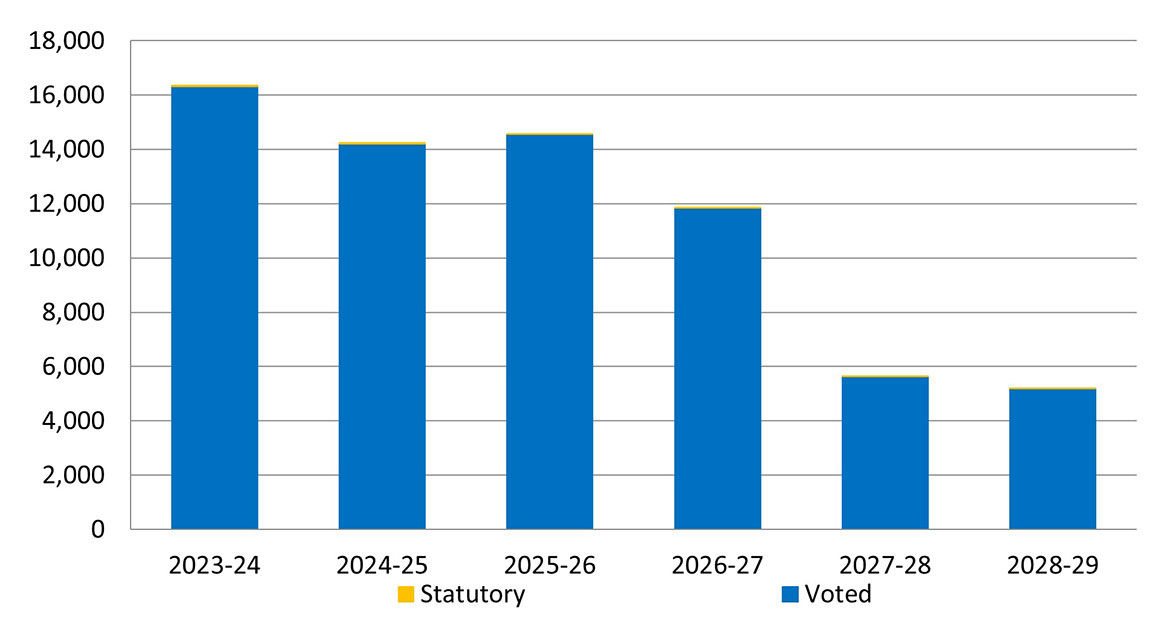
Text alternative for Graph 2: Approved funding (statutory and voted) over a six-year period
| Fiscal year | Total | Voted | Statutory |
|---|---|---|---|
| 2023–24 | 16,351 | 16,310 | 41 |
| 2024–25 | 14,304 | 14,250 | 54 |
| 2025–26 | 14,583 | 14,546 | 37 |
| 2026–27 | 11,869 | 11,835 | 34 |
| 2027–28 | 5,651 | 5,620 | 31 |
| 2028–29 | 5,211 | 5,181 | 30 |
Analysis of statutory and voted funding over a six-year period
This stacked bar graph depicts spending from 2023–24 to 2028–29:
- Total spending in 2023–24 was $16,351M. Of this amount, $16,310M was voted spending and $41M was statutory spending.
- Total spending in 2024–25 was $14,304M. Of this amount, $14,250M is voted spending and $54M is statutory spending.
- Planned spending in 2025–26 is $14,583M. Of this amount, $14,546M is voted spending and $37M is statutory spending.
- Planned spending in 2026–27 is $11,869M. Of this amount, $11,835M is voted spending and $34M is statutory spending.
- Planned spending in 2027–28 is $5,651M. Of this amount, $5,620M is voted spending and $31M is statutory spending.
- Planned spending in 2028–29 is $5,211M. Of this amount, $5,181M is voted spending and $30M is statutory spending.
For further information on CIRNAC's departmental appropriations, consult the 2026–27 Main Estimates.
Future-oriented condensed statement of operations
The future-oriented condensed statement of operations provides an overview of CIRNAC's operations for 2025–26 to 2026–27.
Table 13: Future-oriented condensed statement of operations for the year ended March 31, 2027 (dollars)
Table 13 summarizes the expenses and revenues which net to the cost of operations before government funding and transfers for 2025–26 to 2026–27. The forecast and planned amounts in this statement of operations were prepared on an accrual basis. The forecast and planned amounts presented in other sections of the Departmental Plan were prepared on an expenditure basis. Amounts may therefore differ.
| Financial information | 2025–26 Forecast results |
2026–27 Planned results | Difference (Planned results minus forecasted) |
|---|---|---|---|
| Total expenses | 17,837,387,412 | 13,369,081,352 | (4,468,306,060) |
| Total revenues | 21,422,423 | 22,639,355 | 1,216,932 |
| Net cost of operations before government funding and transfers | 17,815,964,989 | 13,346,441,997 | (4,469,522,992) |
Analysis of forecasted and planned results
Expenses
Total expenses for 2026–27 planned results are $13,369M, representing a $4,468M decrease from the previous year's forecasted total expenses of $17,837M. The decrease is mainly due to a decrease in grants to Crown-Indigenous Relations' programs and a decrease in the accrual adjustment related to the provision for claims and litigation.
2026–27 planned expenses by core responsibilities are as follows:
- Crown-Indigenous Relations $12,475M (93.3%); and
- Northern and Arctic Affairs $691M (5.2%).
The remainder of the total expenses include Internal Services in the amount of $210M (1.6%) and expenses incurred on behalf of the Government of Canada in the amount of -$7M (0.05%).
Revenues
Total revenues for 2026–27 planned results are $22.6M, representing an increase of $1.2M compared to the previous year's forecasted total revenues of $21.4M. The increase is mainly from the revenues for the provision of services to other government departments.
A more detailed Future-Oriented Statement of Operations and associated Notes for 2026–27 including a reconciliation of the net cost of operations with the requested authorities, is available on CIRNAC's website.
Human resources
This section presents an overview of the department's actual and planned human resources from 2023–24 to 2028–29.
Table 14: Actual human resources for core responsibilities and internal services
Table 14 shows a summary of human resources, in full-time equivalents, for CIRNAC's core responsibilities and for its internal services for the previous three fiscal years. Human resources for the 2025–26 fiscal year are forecasted based on year to date.
| Core responsibilities and internal services | 2023–24 Actual full-time equivalents | 2024–25 Actual full-time equivalents | 2025–26 Forecasted full-time equivalents |
|---|---|---|---|
| Crown-Indigenous Relations | 959 | 992 | 869 |
| Northern and Arctic Affairs | 365 | 399 | 379 |
| Subtotal | 1,324 | 1,391 | 1,248 |
| Internal services | 861 | 540 | 506 |
| Total | 2,185 | 1,931 | 1,754 |
Analysis of human resources over the last three years
The decrease of 177 full-time equivalents from 2024–25 to 2025–26, is mainly reflects the sunset of funding for:
- Cowessess First Nation's Child and Family Services Law
- Indigenous infrastructure projects
- Federal framework to address the legacy of residential schools
Table 15: Human resources planning summary for core responsibilities and internal services
Table 15 shows information on human resources, in full-time equivalents, for each of CIRNAC's core responsibilities and for its internal services planned for the next three years.
| Core responsibilities and internal services | 2026–27 Planned full-time equivalents | 2027–28 Planned full-time equivalents | 2028–29 Planned full-time equivalents |
|---|---|---|---|
| Crown-Indigenous Relations | 769 | 735 | 687 |
| Northern and Arctic Affairs | 373 | 363 | 341 |
| Subtotal | 1,142 | 1,098 | 1,028 |
| Internal services | 492 | 486 | 482 |
| Total | 1,634 | 1,584 | 1,510 |
Analysis of human resources for the next three years
The decrease of 120 full-time equivalents from 2025–26 to 2026–27 is due to the sunset of funding for:
- Recognition of Indigenous Rights and Self-Determination
- Canada's New Marine Conservation Targets
The decrease of 50 full-time equivalents from 2026–27 to 2027–28 reflects the sunset of funding for:
- Self-Governing and Modern Treaty First Nation, Inuit, and Métis housing
- Supporting the development of a National Action Plan to eliminate violence against Indigenous women, girls, and 2SLGBTQI+ people
- Continued implementation of An Act respecting First Nations, Inuit and Métis children, youth and families
- Transitioning diesel reliant Indigenous communities onto clean energy
The decrease of 74 full-time equivalents from 2027–28 to 2028–29 reflects the sunset of funding for:
- Implementation of the Impact Assessment Act
- Continued implementation of Truth and Reconciliation Commission's Calls to Action 74 to 76
- More inclusive Indigenous participation in northern environmental decision-making
- Supporting Future Arctic Offshore Energy
Supplementary information tables
The following supplementary information tables are available on CIRNAC's website:
- Details on transfer payment programs
- Horizontal Initiatives
- Regulatory and Permitting Efficiency for Clean Growth Projects
Information on CIRNAC's departmental sustainable development strategy can be found on CIRNAC's website.
Federal tax expenditures
CIRNAC's Departmental Plan does not include information on tax expenditures.
The tax system can be used to achieve public policy objectives through the application of special measures such as low tax rates, exemptions, deductions, deferrals and credits. The Department of Finance Canada publishes cost estimates and projections for these measures each year in the Report on Federal Tax Expenditures.
This report also provides detailed background information on tax expenditures, including descriptions, objectives, historical information and references to related federal spending programs as well as evaluations and GBA Plus of tax expenditures.
Corporate information
Departmental profile
Appropriate ministers:
The Honourable Rebecca Alty (Minister of Crown-Indigenous Relations) and the Honourable Rebecca Chartrand (Minister of Northern and Arctic Affairs and Minister responsible for the Canadian Northern Economic Development Agency)
Institutional head:
Valerie Gideon, Deputy Minister, Crown-Indigenous Relations and Northern Affairs
Ministerial portfolio:
Department of Crown-Indigenous Relations and Northern Affairs
Enabling instrument(s):
Department of Crown-Indigenous Relations and Northern Affairs Act, S.C. 2019, c. 29, s. 337
Year of commencement:
July 15, 2019
Other:
None
Departmental contact information
Telephone:
Toll-free: 1-800-567-9604
Fax:
1-866-817-3977
Email:
- General and statistical inquiries and publication distribution: infopubs@sac-isc.gc.ca
- Media inquiries (communications): RCAANC.media.CIRNAC@sac-isc.gc.ca
- Departmental library: hqlibraryreference@sac-isc.gc.ca
Website:
www.canada.ca/en/crown-indigenous-relations-northern-affairs.html
Definitions
List of terms
- appropriation (crédit)
- Any authority of Parliament to pay money out of the Consolidated Revenue Fund.
- budgetary expenditures (dépenses budgétaires)
- Operating and capital expenditures; transfer payments to other levels of government, departments or individuals; and payments to Crown corporations.
- core responsibility (responsabilité essentielle)
- An enduring function or role performed by a department. The intentions of the department with respect to a core responsibility are reflected in one or more related departmental results that the department seeks to contribute to or influence.
- Departmental Plan (plan ministériel)
- A report on the plans and expected performance of an appropriated department over a 3year period. Departmental Plans are usually tabled in Parliament each spring.
- departmental result (résultat ministériel)
- A consequence or outcome that a department seeks to achieve. A departmental result is often outside departments' immediate control, but it should be influenced by program-level outcomes.
- departmental result indicator (indicateur de résultat ministériel)
- A quantitative measure of progress on a departmental result.
- departmental results framework (cadre ministériel des résultats)
- A framework that connects the department's core responsibilities to its departmental results and departmental result indicators.
- Departmental Results Report (rapport sur les résultats ministériels)
- A report on a department's actual accomplishments against the plans, priorities and expected results set out in the corresponding Departmental Plan.
- full-time equivalent (équivalent temps plein)
- A measure of the extent to which an employee represents a full person-year charge against a departmental budget. For a particular position, the full-time equivalent figure is the ratio of number of hours the person actually works divided by the standard number of hours set out in the person's collective agreement.
- gender-based analysis plus (GBA Plus) (analyse comparative entre les sexes plus [ACS Plus])
- Is an analytical tool used to support the development of responsive and inclusive policies, programs, and other initiatives. GBA Plus is a process for understanding who is impacted by the issue or opportunity being addressed by the initiative; identifying how the initiative could be tailored to meet diverse needs of the people most impacted; and anticipating and mitigating any barriers to accessing or benefitting from the initiative. GBA Plus is an intersectional analysis that goes beyond biological (sex) and socio-cultural (gender) differences to consider other factors, such as age, disability, education, ethnicity, economic status, geography (including rurality), language, race, religion, and sexual orientation.
Using GBA Plus involves taking a gender- and diversity-sensitive approach to our work. Considering all intersecting identity factors as part of GBA Plus, not only sex and gender, is a Government of Canada commitment. - government priorities (priorités gouvernementales)
- For the purpose of the 2026–27 Departmental Plan, government priorities are the high-level themes outlining the government's agenda in the 2025 Speech from the Throne.
- horizontal initiative (initiative horizontale)
- An initiative where two or more federal departments are given funding to pursue a shared outcome, often linked to a government priority.
- Indigenous business (entreprise autochtones)
- Requirements for verifying Indigenous businesses for the purposes of the departmental result report are available through the Indigenous Services Canada Mandatory minimum 5% Indigenous procurement target website.
- non budgetary expenditures (dépenses non budgétaires)
- Non-budgetary authorities that comprise assets and liabilities transactions for loans, investments and advances, or specified purpose accounts, that have been established under specific statutes or under non-statutory authorities in the Estimates and elsewhere. Non-budgetary transactions are those expenditures and receipts related to the government's financial claims on, and obligations to, outside parties. These consist of transactions in loans, investments and advances; in cash and accounts receivable; in public money received or collected for specified purposes; and in all other assets and liabilities. Other assets and liabilities, not specifically defined in G to P authority codes are to be recorded to an R authority code, which is the residual authority code for all other assets and liabilities.
- performance (rendement)
- What a department did with its resources to achieve its results, how well those results compare to what the department intended to achieve, and how well lessons learned have been identified.
- performance indicator (indicateur de rendement)
- A qualitative or quantitative means of measuring an output or outcome, with the intention of gauging the performance of a department, program, policy or initiative respecting expected results.
- plan (plan)
- The articulation of strategic choices, which provides information on how a department intends to achieve its priorities and associated results. Generally, a plan will explain the logic behind the strategies chosen and tend to focus on actions that lead to the expected result.
- planned spending (dépenses prévues)
- For Departmental Plans and Departmental Results Reports, planned spending refers to those amounts presented in Main Estimates.
A department is expected to be aware of the authorities that it has sought and received. The determination of planned spending is a departmental responsibility, and departments must be able to defend the expenditure and accrual numbers presented in their Departmental Plans and Departmental Results Reports. - program (programme)
- Individual or groups of services, activities or combinations thereof that are managed together within the department and focus on a specific set of outputs, outcomes or service levels.
- program inventory (répertoire des programmes)
- Identifies all the department's programs and describes how resources are organized to contribute to the department's core responsibilities and results.
- result (résultat)
- A consequence attributed, in part, to a department, policy, program or initiative. Results are not within the control of a single department, policy, program or initiative; instead they are within the area of the department's influence.
- statutory expenditures (dépenses législatives)
- Expenditures that Parliament has approved through legislation other than appropriation acts. The legislation sets out the purpose of the expenditures and the terms and conditions under which they may be made.
- target (cible)
- A measurable performance or success level that a department, program or initiative plans to achieve within a specified time period. Targets can be either quantitative or qualitative.
- voted expenditures (dépenses votées)
- Expenditures that Parliament approves annually through an appropriation act. The vote wording becomes the governing conditions under which these expenditures may be made.