Protocol on the Engagement, and on the Consultation and Accommodation of the Pekuakamiulnuatsh, the Essipit Innus, and the Nutashkuan Innus
PDF version (859 Kb, 20 pages)
Between
THE PEKUAKAMIULNUATSH FIRST NATION, represented by its Chief, duly authorized by resolution of its Council,
THE ESSIPIT INNU FIRST NATION, represented by its Chief, duly authorized by resolution of its Council,
THE NUTASHKUAN INNU FIRST NATION, represented by its Chief, duly authorized by resolution of its Council,
(Hereinafter collectively referred to as the "First Nations")
And
THE GOVERNMENT OF CANADA, represented by the Minister of Crown-Indigenous Relations, hereinafter referred to as "Canada"
(hereinafter collectively referred to as the "Parties")
(according to the context, the term "Parties" may be used to refer to one or more of the three First Nations as well as Canada)
WHEREAS:
- section 35 of the Constitution Act, 1982 recognizes and affirms the Aboriginal and treaty rights of the Aboriginal peoples of Canada.
- the honour of the Crown requires it to act honourably in all its dealings with Indigenous peoples In particular, the Crown has a constitutional duty to consult and, where appropriate, accommodate Aboriginal peoples when contemplating a measure that may have adverse impacts on their potential or established Aboriginal or treaty rights. Canada must therefore conduct consultations in a reasonable manner and in good faith.
- the First Nations are Aboriginal peoples who assert Aboriginal rights, including Aboriginal title, over their ancestral territories.
- the bond that the First Nations claim to have with their ancestral territories, including its resources, is of fundamental importance for the preservation of their distinctive culture, including Innu Aitun.
- in many ways, Innu Knowledge is an essential component of effective land management.
- the Pekuakamiulnuatsh, Essipit, and NutashkuanFootnote 1 First Nations signed an Agreement-in-Principle of General Nature with Canada and the Government of Quebec on March 31, 2004. This agreement established the structure, general direction, and principles to guide the drafting of a treaty that will address territorial claims and be recognized as a treaty under sections 25 and 35 of the Constitution Act, 1982.
- the Supreme Court of Canada, notably in the Taku River decision, stated that the acceptance of a First Nation's title claim for the purpose of treaty negotiation establishes a prima facie case in support of their claim for Aboriginal rights and title.
- considering Canada's constitutional duty to consult and, where appropriate, accommodate, which flows from section 35 of the Constitution Act, 1982, the Parties wish to establish through this Protocol a clear and efficient process that they can follow and that will also contribute to strengthening the relationship between the Parties.
- it is in the interest of the Parties that Canada initiates a consultation conducted under this Protocol as early as possible in the planning of its decision-making process.
THEREFORE, the Parties agree as follows.
1. Definitions
Words in the singular include the plural, and words in the plural include the singular unless the context or a definition provided in this Protocol specifies otherwise.
The following definitions apply for the purposes of this Protocol:
- 1.1. "Framework" means a federal initiative that would not, at first glance, lead to the implementation of a Conduct, including proposed laws, regulations, plans, and policies contemplated by Canada that could have significant effects on the interests of the First Nations.
- 1.2. "Supplementary Consultation Agreement" means an agreement made between the First Nations and a federal department or agency to clarify, adapt, or replace this Protocol, in whole or in part.
- 1.3. "Innu Aitun" Innu Aitun designates all activities, in their traditional or modern manifestation, relating to the national culture, fundamental values and traditional lifestyle of the Innus associated with the occupation and use of NitassinanFootnote 2 and to the special bond they have with the land. These include all practices, customs, and traditions, including hunting, fishing, trapping, and gathering activities for subsistence, ritual or social purposes. All spiritual, cultural, social and community aspects are an integral part thereof. Innu Aitun entails the utilization of animal species, plants, rocks, water, and other natural resources for food, ritual or social purposes and for subsistence purposes.
- 1.4. "Conduct" means an action that Canada, including federal departments and agencies, is considering in territorial and governance matters, including but not limited to designations, authorizations and other decisions that may have adverse impacts on any potential or established Aboriginal rights, including Aboriginal title, and related interests of the First Nations.
- 1.5. "Engagement" means a communication activity that aims to pool thoughts and actions to which First Nations are invited regarding a Framework.
- 1.6. "Nitassinan" for the purposes of this Protocol means the consultation areas, which are the territories agreed upon for each of the First Nations described and represented in Appendixes I, IA and IB, subject to future modifications by the First Nations.
- 1.7. "First Nations" means the following three First Nations: the Pekuakamiulnuatsh First Nation, the Essipit Innu First Nation, and the Nutashkuan Innu First Nation. However, the term can be used to refer to one, or two of the three First Nations.
- 1.8. "Innu knowledge" means empirical knowledge, knowledge, know-how, skills, and practices that are developed, sustained and passed on from generation to generation within First Nations, often forming part of its cultural or spiritual identity.
2. Purpose
- 2.1. This Protocol establishes a process for consulting and accommodating, where appropriate, the First Nations when Canada, including departments and federal agencies, is considering Conduct, as defined in this Protocol, that may have an adverse impact on any of their potential or established Aboriginal rights, including Aboriginal title, and related interests on the Nitassinan.
- 2.2. The consultation and accommodation process described in this Protocol can also be used, if necessary, for the Engagement of the First Nations by Canada, with the necessary adaptations.
- 2.3. The Parties aim to make the process established by this Protocol the preferred approach to fulfill their mutual obligations regarding consultation and accommodation, which does not prevent them, as long as the duty to consult obligation is met, from:
- participating in consultations independently of the consultation and accommodation process provided for in this Protocol;
- concluding other consultation agreements with a third party; and
- concluding a Supplementary Consultation Agreement with a federal department or agency on regarding any consultations on a specific or generic subject, or on a particular project conducted by such department or agency.
- 2.4. This Protocol, as well as any Supplementary Consultation Agreements that may be concluded in each situation, aims to enable a specific consultation with the First Nations so that Canada can truly take into account their concerns and adequately fulfill its constitutional obligations.
3. First Nations Participation
- 3.1. Each First Nation has its own structure to respond to government consultations. They generally work together when a consultation involves more than one First Nation.
- 3.2. During each consultation concerning it, each First Nation decides whether to participate separately or jointly with one or both of the other First Nations and this decision will be shared with Canada in writing.
- 3.3. It is also understood that only the First Nations affected by a Conduct are consulted, based on the potential adverse impacts of the Conduct on their Aboriginal rights, including their potential or established Aboriginal title, and related interests on the Nitassinan.
- 3.4. Notices regarding a consultation are sent as early as possible by Canada to the contact information provided in Appendix II.
- 3.5. A First Nation can notify Canada in writing that it wishes to be consulted and, where appropriate, accommodated with respect to a Conduct for which it has not already received notice. In this case, the First Nation must provide the reasons, in its opinion, why the Conduct may have adverse impacts on the First Nation's Aboriginal rights, including potential or established Aboriginal title, and related interests on its Nitassinan.
4. Canada's Participation
- 4.1. Canada consults a First Nation in accordance with this Protocol through the federal ministries and agencies that are responsible for the Conduct.
- 4.2. To the extent possible, federal departments and agencies adopt a coordinated approach to consultation and, where appropriate, accommodation to promote the efficiency and effectiveness of the process.
- 4.3. When multiple state actors and decision-making bodies in Canada and the provinces are involved in the regulation of an activity, and Canada is considering a resulting Conduct, Canada, to the extent possible, promotes a coordinated approach that allows for meaningful consultation with the First Nations.
- 4.4. When this allows Canada to fulfill in whole or in part its constitutional obligations to consult and, where appropriate, accommodate, it:
- to the extent possible, relies on existing processes and mechanisms, such as environmental assessment and regulatory approval processes (e.g., federal agencies, boards, and regulators); and
- may rely on the consultation activities of a third party (e.g., those of departments, provincial government agencies, and proponents).
- 4.5. If, during a consultation with a First Nation, Canada wants to use information obtained through another existing or previous consultation process with the same First Nation, it informs the latter. The Parties discuss the relevance of the information regarding the proposed Conduct, and if the First Nation deems it necessary, they may supplement the information thus obtained.
- 4.6. For the purposes of article 4.4(b), when Canada obtains information from a third party to the consultation regarding a First Nation, it shall contact this same First Nations to allow it, if the latter deems necessary, to verify, validate and complete the information thus obtained.
- 4.7. As required, elements of the consultation and accommodation process set out in this Protocol can be integrated into or added by Canada, in a complementary manner, to the various existing regulatory approval mechanisms and processes in order to ensure that Canada's duty to consult and, where appropriate, accommodate, is met.
- 4.8. When Canada relies on the consultation activities of third parties to help fulfill its duty to consult and, where appropriate, accommodate, it informs the First Nations as soon as possible.
- 4.9. At the start of each fiscal year, Canada will provide the First Nations with a list of Conducts and Frameworks contemplated by Canada for that fiscal year on the Nitassinans. This list shall also include Conducts taking place outside the Nitassinan but likely to have an adverse impact inside them, including any Conduct that is part of an existing impact assessment or regulatory approval mechanism or process.
- 4.10. The fact that a Conduct or Framework contemplated by Canada is not on the list under Article 4.9, shall not prevent the Parties from relying on this Protocol to undertake consultation about the Conduct, or Engagement related to the Framework.
- 4.11. When the First Nations inform Canada that they want to be consulted regarding a specific Conduct, Canada does not refuse to consult with the First Nations solely on the grounds that the risks of adverse impacts of the Conduct appears to be exclusively outside Nitassinan.
5. Engagement
- 5.1. Canada invites the First Nations to participate in Engagements that may directly concern them, even if the Engagements have no direct links to Nitassinan.
- 5.2. During the initial discussions between the First Nations and the federal authority responsible for the Engagement, the Parties clarify the scope of the Engagement and confirm that it will not, at first glance, lead to the implementation of a Conduct.
- 5.3. At any time in the course of the Engagement, First Nations may inform Canada that they are concerned that it may lead to adverse impacts, including cumulative effects, on potential or established Aboriginal rights, including Aboriginal title and related interests, for the reasons that the First Nations transmit in writing.
- 5.4. Canada analyzes the opinion provided by the First Nations and determines, where appropriate, whether to apply the consultation and accommodation process to aspects of the Engagement that could have adverse impacts on these rights and related interests. Canada must communicate this preliminary analysis to the First Nation.
- 5.5. In the event that Canada believes that the consultation and accommodation process is justified for certain aspects of an Engagement, the Parties shall mutually agree on its application and make any necessary adjustments.
6. Consultation and Accommodation Process
A – Preliminary Step: Discussions Regarding the Consultation and Accommodation Process
- 6.1. When Canada contemplates a Conduct that may have adverse impacts on any potential or established Aboriginal rights, including Aboriginal title, and related interests of a First Nation on a Nitassinan, it communicates with the First Nation by providing it with the relevant information available on the nature of the Conduct.
- 6.2. The First Nation may request additional information from Canada regarding the Conduct to determine if it is likely to have adverse impacts, including cumulative effects, on any potential or established Aboriginal rights, including Aboriginal title, and related interests on its Nitassinan.
- 6.3. The First Nation shall review the information provided concerning the Conduct and shall notify Canada:
- that consultation is not required and that it will not oppose the Conduct;
- that the Conduct may have adverse impact, including cumulative effects, on potential or established Aboriginal rights, including Aboriginal title, and related interests for reasons that the First Nation shall set out; and
- that the First Nation wishes to present its perspective regarding the scope of the consultation and accommodation process appropriate for the circumstances of a Conduct and any other perspective or information it deems relevant.
- 6.4. Canada shall conduct a preliminary analysis of the scope of the consultation and accommodation process, specifically taking into account the frequency and anticipated extent of the adverse impact on asserted or established Aboriginal rights, including Aboriginal title, as well as the related interests of the First Nations.
Before the consultation process continues, Canada shall share this preliminary analysis with the First Nation. The latter can then submit its concerns or any additional relevant information and request discussions with Canada. Canada shall then determine the scope of the consultation and accommodation process.
B – Consultation and Accommodation Process
- 6.5. When Canada holds a consultation, it notifies the First Nation in writing as soon as possible and provides it with: 1) the most relevant and up-to-date information regarding the Conduct, as well as 2) verbal or written explanations regarding Canada's planned consultation process. This information and these explanations, at this stage of the Conduct, include in particular:
- the names of Canada's representatives for this consultation;
- its reliance, where applicable, on the processes of a department or other federal agency, or any other body;
- the form of the consultation (e.g., a private or public meeting with the band council or community members, oral or written communications, site visits);
- the projected timeline for this consultation, including the times when the First Nation will be consulted and specifying the timelines for response that will be granted to them;
- the projected timeline for the implementation of the Conduct;
- the funding that the First Nation could receive in order to enable them to participate meaningfully in the consultation; and
- at Canada's discretion, a list of other Indigenous groups that will be consulted on the Conduct and any changes to this list.
- 6.6. The First Nation shall review the information provided concerning the proposed consultation and shall notify Canada of any request to modify the planned consultation process, including its format and its projected timeline.
- 6.7. The Parties may agree to meet to discuss possible adjustments to the contemplated consultation process.
- 6.8. Canada shall assess any request for modification to the contemplated consultation process and, to the extent possible, shall seek to adjust it to allow for a meaningful and reasonable participation by the First Nation, particularly with regard to reasonable timelines and funding.
- 6.9. Canada provides the First Nation with its decision on the consultation process applicable to the Conduct in writing and explains it.
- 6.10. The First Nation shall, within a reasonable period of time:
- analyze the information provided by Canada;
- explain to Canada the nature and scope of Aboriginal rights, including Aboriginal title, and related interests on which the Conduct may have an adverse impact, including any cumulative effects;
- provides all relevant information about Innu Knowledge to Canada to ensure that it is taken under consideration in the assessment of the Conduct's adverse impacts;
- specifies the frequency and extent of the adverse impact of the Conduct by Canada on Aboriginal rights, including Aboriginal title, and related interests of the First Nation; and
- propose, where appropriate, accommodation measures to reconcile the potential or established Aboriginal rights, including Aboriginal title, and interests of the First Nation involved.
- 6.11. Before implementing a Conduct, Canada shall consider the information and concerns communicated by the First Nation, conducts a comprehensive review of this information and these concerns, and responds to them, in particular by considering the proposed or retained accommodation measures.
- 6.12. If necessary, the Parties shall work together in order to develop appropriate accommodation measures to avoid or reduce, where appropriate, any adverse impact of the Conduct. If the Parties agree that it is impossible to avoid or significantly reduce the adverse impacts of the Conduct, Canada shall determine whether monetary compensation or another form of compensation, such as job or business opportunities, a land swap or royalties would be appropriate. Canada may also rely on such compensation provided by the proponent concerned.
- 6.13. It is understood that the First Nation must have been consulted on the latest version of the Conduct when it has been modified in a way that would alter the conclusions of the assessment of adverse impacts, including cumulative effects, on potential or established Aboriginal rights, including Aboriginal title, and related interests of the First Nation and, where applicable, their scope.
- 6.14. Prior to implementing a Conduct, Canada shall seek to obtain the consent of the First Nation.
- 6.15. If there are reasonable grounds to believe that a Conduct must be adopted urgently, Canada can act without consulting the First Nation beforehand. Canada shall then inform the First Nation, as soon as possible, of the Conduct that has been adopted and the grounds for doing so.
- 6.16. As soon as the emergency is over, Canada shall, depending on the state of the situation, continue to apply this Protocol.
C – Feedback
- 6.17. Canada shall respond in writing to the information and concerns provided by the First Nation and shall explain how this information and these concerns will be taken into account in the decision-making process regarding the Conduct.
- 6.18. Before implementing the Conduct, Canada shall provide written notice to the First Nation within a reasonable timeframe of any decisions made regarding the Conduct.
- 6.19. Subject to legal constraints regarding confidentiality, including Cabinet confidential documents or solicitor-client privilege, Canada provides written reasons for its decision and explains it, including in response to the adverse impacts anticipated by the First Nation and, where appropriate, the accommodation measures retained, including in cases where the consent of the First Nations has not been obtained.
- 6.20. At the request of the First Nations, the Parties agree on a mechanism to monitor the implementation of accommodation measures and their adaptation, if necessary.
7. Legal Scope
- 7.1. Nothing in this Protocol is intended to alter any requirements to which Canada is subject in law. It is understood that this includes any obligation regarding privilege, confidentiality, or protection of personal information that Canada may be subject to.
- 7.2. This Protocol is not subject to settlement privilege and may be tendered as evidence in a court of law or in other legal proceedings, subject to any rules of admissibility of evidence applicable before that court or body.
- 7.3. Unless the Parties avail themselves of provisions concerning the confidentiality of certain information exchanged under Sections 8 and 9, consultation conducted pursuant to this Protocol is not subject to settlement privilege, and evidence respecting consultation activities may be tendered as evidence in a court of law or in other legal proceedings in accordance with Article 8.7, subject to any rules of admissibility of evidence applicable before that court or body.
- 7.4. This Protocol shall not have the effect of:
- modifying any legal obligations to which Canada is subject;
- modifying or defining the duty to consult and, where appropriate, accommodate;
- creating a commitment to undertake a consultation or to reach agreement of any kind pursuant to this Protocol;
- preventing the First nations from exercising any right that it may have under the applicable Canadian legal framework, including the common law, in relation to the constitutional duty to consult and, where appropriate, accommodate;
- representing the views of either party concerning the nature and scope of any duty to consult, or be interpreted as an admission by either Party;
- preventing the First Nations from turning to the courts or any other legal proceeding to enforce Canada's duty to consult and, where appropriate, accommodate; and
- recognizing, denying, creating, extinguishing, abrogating, defining, or overriding any Aboriginal right or interest that the First Nations may have.
- 7.5. Canada recognizes that the maps attached to the Protocol cannot prevent the First Nations from asserting or proving in other contexts the existence of their ancestral territories and associated Aboriginal rights, including Aboriginal title, based on research conducted by the First Nations and historical, anthropological, and archaeological knowledge of their ancestral territories and Aboriginal rights.
- 7.6. First Nations may eventually submit new maps of Nitassinan to Canada in order to supplement the maps referred to in Article 1.6 of this Protocol, and Canada ensures that it updates the Aboriginal Treaty and Rights Information System (ATRIS), or any tool in effect at that time, to enable the implementation of this Protocol.
- 7.7. During a consultation on a Conduct concerning the new areas of territory covered by the maps under Article 7.6, Canada will determine the extent of the consultation and accommodation process based on a preliminary analysis of the strength of the assertions of Aboriginal rights of the First Nations, including Aboriginal title and related interests, and will communicate the results of this analysis to the First Nations.
8. Confidentiality
- 8.1. This document is not confidential and may be made public. However, with regard to the maps annexed to this Protocol, the Parties must agree on the manner in which they are disseminated.
- 8.2. With respect to any consultation activities conducted pursuant to this Protocol, the Parties participating in the consultation and accommodation process may share information, including documents and Innu Knowledge, amongst each other on a confidential basis.
- 8.3. When a Party wishes to share confidential information as part of the consultation and accommodation process provided for in this Protocol, it notifies the other Party to the consultation. The Parties shall discuss the confidentiality of the information in question. If the Party that is supposed to receive the information does not consider it to be confidential and does not agree to treat it as such, the Party wishing to provide it will have the choice to remove it from the consultation and accommodation process or to keep it there without it being treated as confidential.
- 8.4. The written record of a consultation activity shall not contain any information that the Parties have agreed to treat as confidential in order to maintain its confidentiality. Any information that the Parties agree to treat as confidential shall be marked as such and shall not be disclosed unless required by law or a court.
- 8.5. Without prejudice to its confidentiality, confidential information may be freely circulated among federal departments and agencies for the purposes of the same consultation and, unless a Party requires otherwise, for the purposes of other consultation activities with the same First Nation.
- 8.6. Where confidential information prepared in the course of a specific consultation with a First Nation is shared from one federal department or agency to another in order to assist that department or agency in determining or fulfilling, as appropriate, its duty to consult and accommodate on a new Conduct with that First Nation, the latter department or agency will contact that First Nation to verify that the information is relevant and complete in light of the new Conduct.
- 8.7. Nothing in this section of this Protocol is intended to prevent a Party from tendering confidential information as evidence before a court of law or in other legal proceedings when the information is relevant to an issue of whether the constructional duty to consult and, where appropriate, accommodate was met or fulfilled whether through a consultation and accommodation process conducted pursuant to this Protocol or not.
- 8.8. The Parties may file confidential information in evidence before a court or any other legal proceeding if they have jointly agreed in advance to the terms for disclosing that confidential information in question. In the event of a disagreement between the parties about the confidential nature of the information or the terms for disclosing it, the rules of evidence applicable to the judicial body seized of the matter shall apply.
9. Parties May Proceed Without Prejudice
- 9.1. Notwithstanding any other provision of this Protocol, in order to permit frank, cooperative and solution-oriented interaction without concern for the legal significance of admissions, concessions, positions and discussions, the Parties participating in a consultation process pursuant to this Protocol have the right to establish, before or during the consultation, that certain discussions will be held or that certain information will be exchanged without prejudice until such time as the Parties indicate otherwise.
10. Financing Provided by Canada
- 10.1. A financial contribution from the Department of Crown-Indigenous Relations will be provided to First Nations to enable them to develop and maintain expertise and capacity in consultation and accommodation within the First Nations and support their activities for the purpose of this Protocol.
- 10.2. This funding shall be provided, subject to the allocation of the necessary appropriations by Canada, based on an annual budget submitted by the First Nations.
- 10.3. Each department and federal agency involved in a consultation with a First Nation, conducted in accordance with this Protocol, will also consider the needs related to consultations related to each proposed Conduct and, where applicable, will determine, after discussion with the First Nation, the funding arrangements based on the specific needs of the consultation and accommodation process.
- 10.4. The assessment of the First Nation's financing needs must be done as early as possible in the consultation process.
11. Review and Revision of this Protocol
- 11.1. The First Nations will participate once a year in the meetings of the Federal Network on Indigenous Consultation in QuebecFootnote 3 to discuss the implementation of this Protocol.
- 11.2. Every twenty-four (24) months after the signing of this Protocol, the parties shall review the Protocol and its process and determine if it needs any amendments. This review shall include, among other things, the following objectives:
- determine how often the parties use the consultation and accommodation process;
- assess the effectiveness of the consultation and accommodation process, including the extent to which it has facilitated consultations and the extent to which it has resulted in satisfactory accommodations;
- identify the reasons why they have chosen to not use the process, where applicable; and
- determine whether this Protocol requires any amendments.
- 11.3. The Parties will meet for a review similar to the one indicated in Article 11.2 periodically, but no later than sixty (60) months after the review provided for in Article 11.2 and no later than every sixty (60) months thereafter.
- 11.4. The Parties will also meet for a similar review as indicated in Article 11.2 at the time of the implementation of a treaty or any other agreement providing for a consultation and accommodation process.
- 11.5. Any notice regarding the review and revision of the Consultation and Accommodation Protocol must be sent by Canada to the First Nations.
- 11.6. This Protocol may be modified with the written consent of the Parties or through their authorized representatives.
- 11.7. The examination, review, and interpretation of this Protocol are guided by developments in the applicable law.
12. Coming Into Effect and Termination
- 12.1. This Consultation Protocol shall enter into force on the date of its signature and shall remain in force unless it is terminated:
- either by Canada with three (3) months written notice to the three First Nations, setting out the reasons for this decision;
- either by the three First Nations with three (3) months written notice to Canada, setting out the reasons for this decision; or
- either by agreement of the Parties, at the time of implementation of a treaty or other agreement providing for a process of consultation and accommodation.
- 12.2. A First Nation may withdraw from this Protocol at any time by providing the other First Nations and Canada with a duly authorized band council resolution confirming its decision. This same First Nation may rejoin it with the written consent of the other First Nations and Canada.
- 12.3. This Protocol was written in French and translated into English. The French version of this Protocol is authoritative. In case of any discrepancy between the French and English versions of the text of this Protocol, the French version shall prevail.
Appendix I - Nitassinan - Consultation Zones
- The First Nations assert that the Nitassinan, briefly explained in the present annex, and the following maps (IA, IB) are the result of the negotiation process for the Agreement-in-Principle of General Nature, concluded with Canada in 2004, except for the part of Nitassinan located in Labrador mentioned in paragraph d), a negotiation process based on a federal comprehensive land claims policy in effect at the time.
- The First Nations assert that the territories represented on the attached maps (namely the Nitassinan agreed upon for the purposes of the Protocol) do not represent the entirety of their ancestral territories.
- The First Nations assert that the South-West Part is a Nitassinan shared by the Pekuakamiulnuatsh and Essipit Innu First Nations.
- A portion of the Nitassinan of the Nutashkuan Innu First Nation is located in Labrador. The assertion regarding the portion of this territory shown on the attached map IB is based on the historical, anthropological, and archaeological knowledge of the millennium-long occupation by the Nutashkuan Innu and is also supported by contemporary facts. This assertion, according to current knowledge and positions, is part of a context of shared rights and interests with other Innu First Nations on this part of the territory.
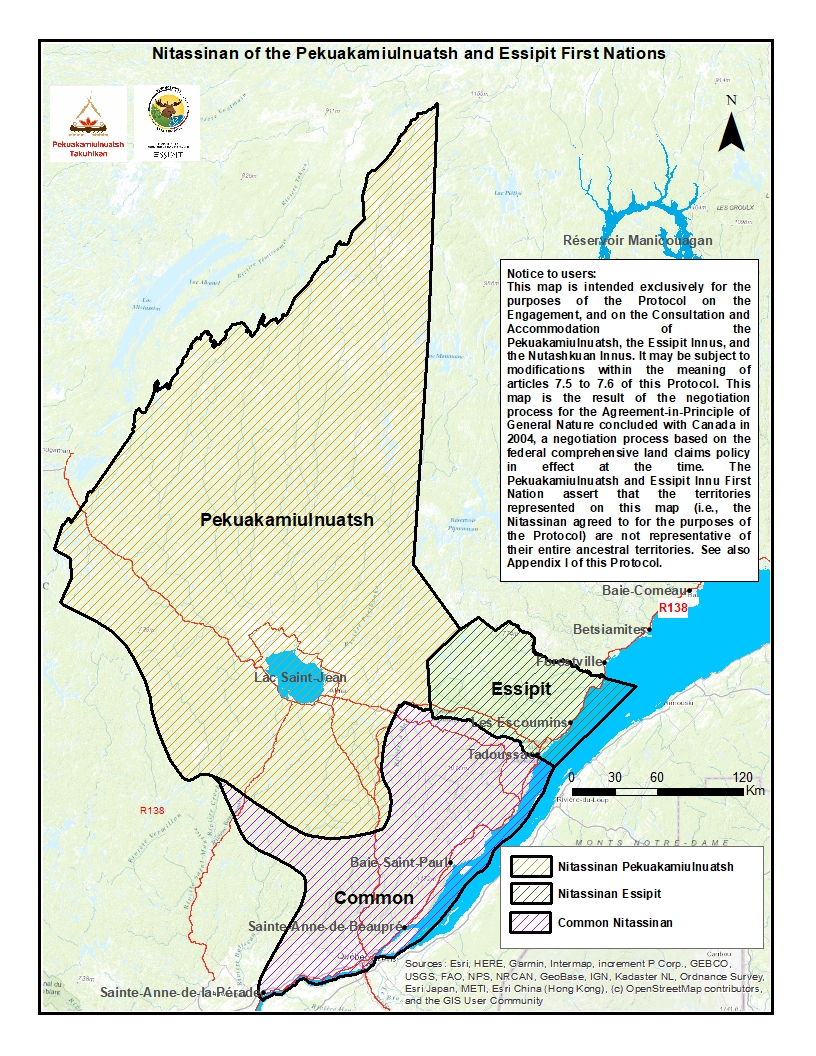
Text alternative for A. Of the Pekuakamiulnuatsh and Essipit Innu First Nations
This image is a map. The top left corner has the logo of the Pekuakamiulnuatsh (Pé-quoi-ka-mil-nou-ats) and Essipit (Es-si-pit) First Nations. Top center is the name of the map. On the top right corner is an arrow with the letter N above it to indicate north.
The map includes a notice to users which indicates:
"This map is intended exclusively for the purposes of the Protocol on the Engagement, and on the Consultation and Accommodation of the Pekuakamiulnuastsh, the Essipit Innus and the Nutashkuan Innus. It may be subject to modifications within the meaning of articles 7.5 to 7.6 of this Protocol. This map is the result of the negotiation process for the Agreement-in-Principle of the General Nature concluded with Canada in 2004, a negotiation process based on the federal comprehensive lands claims policy in effect at the time. The Pekuakamiulnuatsh and Essipit First Nations assert that the territories represented on this map (i.e., the Nitassinan agreed to for the purpose of the Protocol) are not representative of their entire ancestral territories. See Also Appendix I of this protocol."
The map identifies 3 geographic areas within the province of Quebec and on the north shore of the St. Lawrence River that border each other. The first area is called the Nitassinan (Nit-as-sin-an) of the Pekuakamiulnuatsh, the second is called the Nitassinan of Essipit First Nation and the third geographic location which is of shared interests of both First Nations is a common area, called Common Nitassinan.
Bottom right corner are the sources from which the map was created:
Esri, HERE, Garmin, Intermap, increment P Corp., GEBCO, USGS, FAO, NPS, NRCAN, GeoBase, IGN, Kadaster NL, Ordnance Survey, ESRI Japan, Esri China (Hong Kong), © OpenStreetMap contributors, and the GIS User Community.
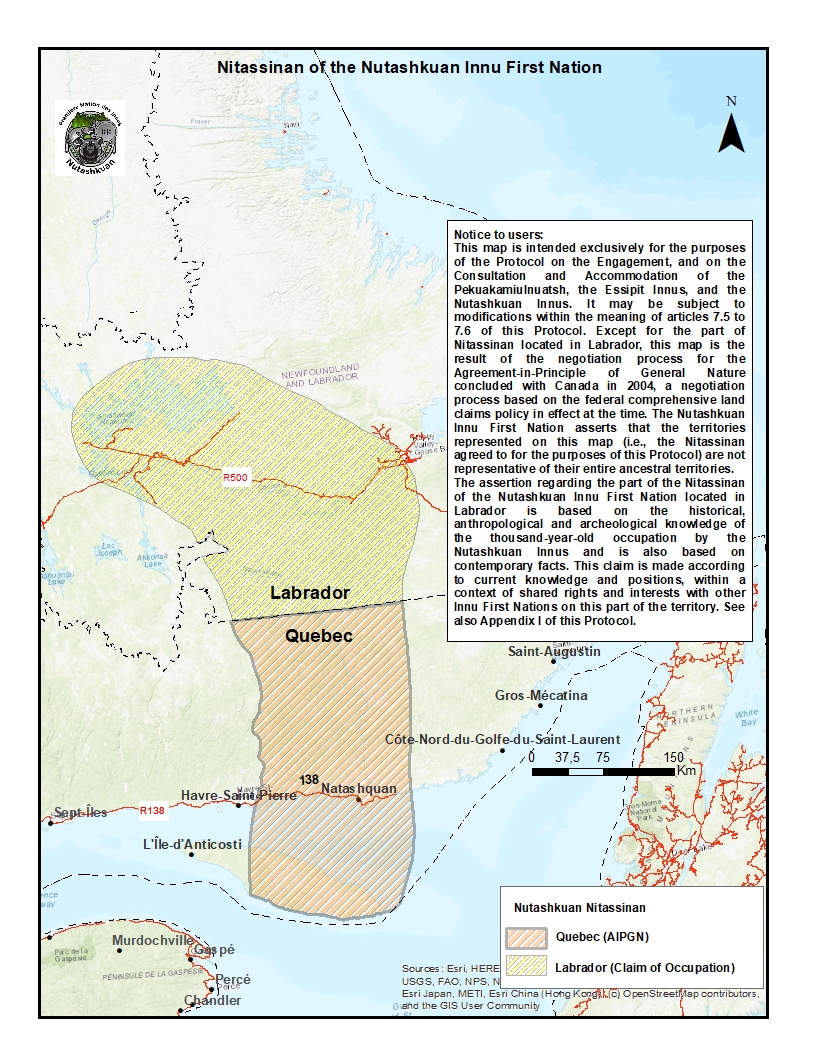
Text alternative for B. Of the Nutashkuan Innu First Nation
This image is a map. The top left corner has the logo of the Nutashkuan (Nou-tash-kouan)First Nation. Top center is the name of the map. On the top right corner is an arrow with the letter N above it to indicate north.
The map includes a notice to users which indicates:
"This map is intended exclusively for the purposes of the Protocol on the Engagement, and on the Consultation and Accommodation of the Pekuakamiulnuastsh, the Essipit Innus and the Nutashkuan Innus. It may be subject to modifications within the meaning of articles 7.5 to 7.6 of this Protocol. Except for the part of the Nitassinan located in Labrador, this map is the result of the negotiation process for the Agreement-in-Principle of the General Nature concluded with Canada in 2004, a negotiation process based on the federal comprehensive lands claims policy in effect at the time. The Nutashkuan Innu First Nation asserts that the territories represented on this map (i.e., the Nitassinan agreed to for the purpose of the Protocol) are not representative of their entire ancestral territories. The assertion regarding the part of the Nitassinan of the Nutashkuan Innu First Nation located in Labrador is based on the historical, anthropological, and archeological knowledge of the thousand-year-old occupation by the Nutashkuan Innus and is also based on contemporary facts. This claim is made according to current knowledge and positions, within a context of shared rights and interests with other Innu First Nations on this part of the territory. See also Appendix I of this protocol."
The map identifies one geographic area that is made up of 2 portions. One portion extends northward from the north shore of the St. Lawrence River within the province of Quebec and continues into the province of Labrador.
Bottom right corner are the sources from which the map was created:
Esri, HERE, Garmin, Intermap, increment P Corp., GEBCO, USGS, FAO, NPS, NRCAN, GeoBase, IGN, Kadaster NL, Ordnance Survey, ESRI Japan, Esri China (Hong Kong), © OpenStreetMap contributors, and the GIS User Community.
Appendix II. Contact information for First Nations representatives
The contact information of the First Nations representatives in this appendix can be changed by a simple notice from a First Nation representative.
Below are all the addresses to which any correspondence and notice from Canada under the Protocol must be sent. As for the Consultations or Engagements concerning the South-West Part (common Nitassinan), they will be addressed to the Pekuakamiulnuatsh First Nation and the Essipit Innu First Nation.
Pekuakamiulnuatsh First Nation:
Pekuakamiulnuatsh Takuhikan, Office of Rights and Territory Protection
1671 Ouiatchouan Street
Mashteuiatsh, Quebec
G0W 2H0
Telephone: 418 275-2473
Fax: 418 275-7615
Email: dpt@mashteuiatsh.ca
Essipit Innu First Nation:
Chief of the Essipit First Nation
32 Reserve Street
Essipit, Quebec
G0T 1K0
Telephone: 418 233-2509
Fax: 418 233-2888
Email: consultations@essipit.com
and/or;
Essipit Innu First Nation Council, Office of Development and Territory
32 Reserve Street
Essipit, Quebec
G0T 1K0
Telephone: 418 233-2509
Fax: 418 233-2888
Email: consultations@essipit.com
Nutashkuan Innu First Nation:
Chief of the Nutashkuan Innu First Nation
78 Mashkush Street
Nutashkuan, Quebec, G0G 2E0
Telephone: 418 726-3529
Fax: 418 726-3606
Email: chef@nutashkuan.ca
and/or;
Nutashkuan Innu First Nation Council
78 Mashkush Street
Nutashkuan, Quebec, G0G 2E0
Telephone: 418 726-3529
Fax: 418 726-3606
Email: sec.admin.conseil@nutashkuan.ca
Signatures
ESSIPIT INNU FIRST NATION
Chief Martin Dufour
Essipit Innu First Nation
Signed this 03 day of 03 2025
NUTASHKUAN INNU FIRST NATION
Chief Réal Tettaut
Nutashkuan Innu First Nation
Signed this 03 day of 03 2025
PEKUAKAMIULNUATSH FIRST NATION
Chief Gilbert Dominique
Pekuakamiulnuatsh First Nation
Signed this 03 day of 03 2025
HIS MAJESTY THE KING IN RIGHT OF CANADA
Gary Anandasangaree
Minister of Crown-Indigenous Relations and Northern Affairs
Signed this 05 day of 03 2025